Modifier 78 - Guide on when, how, and what to use it for
Modifier 78 Quick Summary
Modifier 78 is used to report an unplanned return to the operating or procedure room by the same physician or qualified health care professional for a related procedure during the postoperative (global) period of an initial surgery. Its primary purpose is to notify the payer that the patient required additional operative intervention due to complications or conditions directly related to the original procedure. From a CMS and payer perspective, Modifier 78 does not reset the global period and does not establish a new postoperative window. Instead, it allows limited reimbursement for the intraoperative portion of the subsequent procedure while maintaining the original global surgical package.
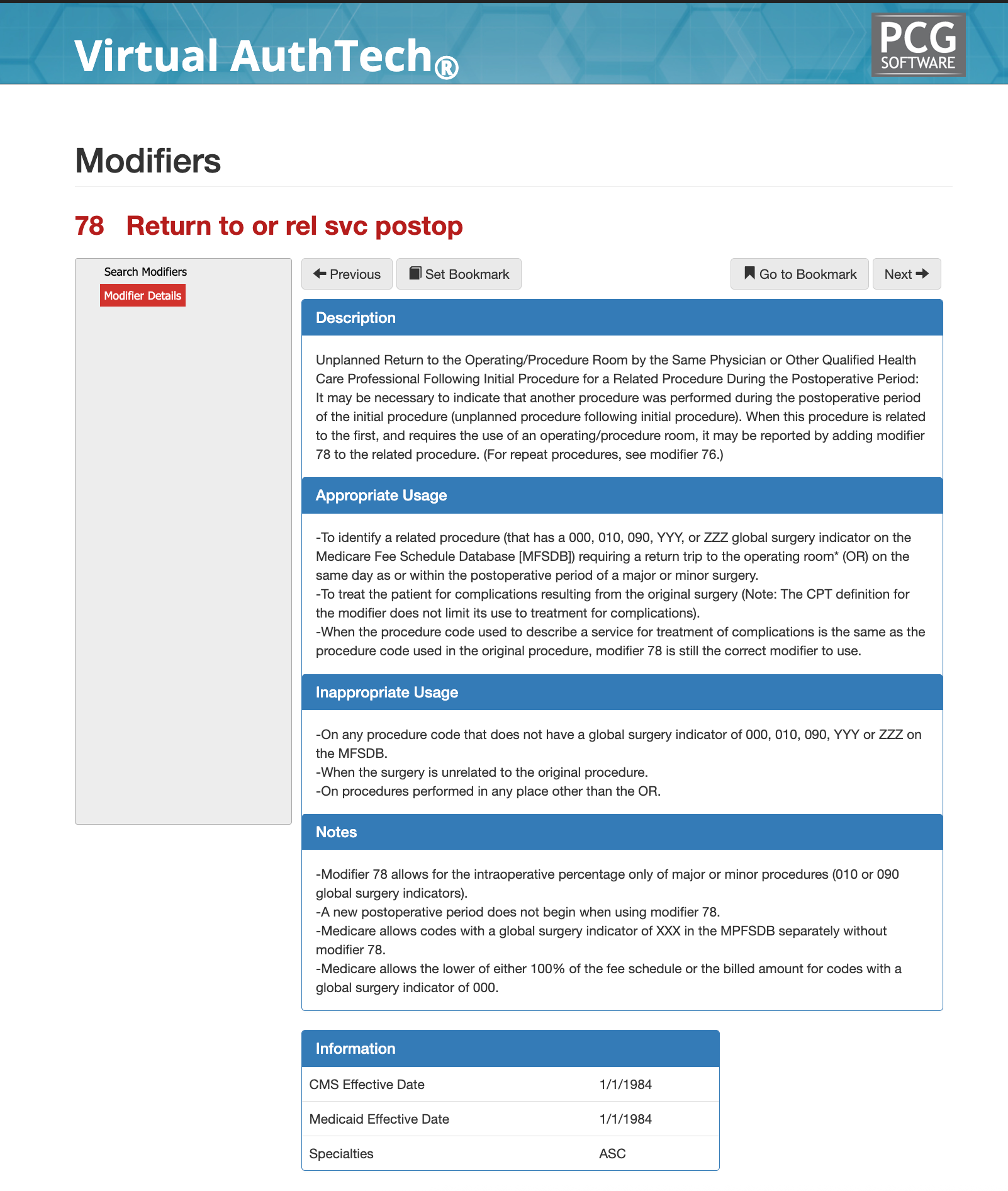
Modifier 78 Description & Usage
Modifier 78 indicates that a patient required an unplanned return to the operating or procedure room during the global period of a prior surgery for a related condition or complication. The return must be clinically necessary, unanticipated at the time of the original surgery, and require operative intervention. This modifier applies only when the subsequent procedure is performed by the same physician or provider group and occurs within the postoperative period of a procedure that carries a global surgical indicator. The key distinguishing factor is that the second procedure is related, unlike Modifier 79, and unplanned, unlike Modifier 58.
When can I use Modifier 78 appropriately?
Modifier 78 should be used when all of the following conditions are met:
- The patient is within the postoperative (global) period of a prior procedure
- The patient experiences a complication or related condition from the original surgery
- An unplanned return to the operating or procedure room is required
- The procedure is performed by the same physician or qualified health care professional
- The procedure is related to the original surgery
- The service is not staged, planned, or anticipated at the time of the initial procedure
From an adjudication standpoint, Modifier 78 signals that the service is part of postoperative complication management requiring operative care but does
not warrant full global reimbursement.
Example 1: Postoperative Bleeding Requiring Return to the OR
A patient undergoes a total thyroidectomy and later presents during the global period with acute postoperative hemorrhage. The patient is taken back to the operating room for surgical control of bleeding. The operative note confirms that the bleeding is a complication of the original surgery and that the return was unplanned.
Modifier 78 is appropriate because the service represents an unplanned return to the OR for a related complication, and no new global period is established.
Example 2: Infection Requiring Surgical Debridement
Following an open abdominal procedure, the patient develops a postoperative wound infection requiring operative debridement during the global period. The surgeon documents the infection as a complication of the initial surgery and performs debridement in the operating room.
Modifier 78 applies because the procedure is related, unplanned, and requires operative intervention.
Example 3: Anastomotic Leak After Bowel Surgery
A patient returns during the postoperative period with signs of sepsis related to an anastomotic leak from a prior bowel resection. The patient is taken back to surgery for repair. Documentation confirms the leak is a complication of the original procedure.
Modifier 78 is appropriate because the return to the OR is unplanned and directly related to the original surgery.

When is it not appropriate to use Modifier 78?
Modifier 78 should not be reported in the following situations:
- The procedure is unrelated to the original surgery
- The service was planned or staged at the time of the initial procedure
- The service does not require a return to an operating or procedure room
- The procedure represents routine postoperative care or follow-up
- The procedure is performed by a different provider
- The service occurs outside of the global period
If the service is planned, Modifier 58 may apply. If the service is unrelated, Modifier 79 is the correct modifier. Using Modifier 78 inappropriately to obtain partial reimbursement for non-qualifying services is a common cause of payer denials and audits.
Example 1: New Diagnosis During the Global Period
A patient undergoes arthroscopic knee surgery and later presents during the postoperative period with acute abdominal pain. Evaluation confirms appendicitis, requiring an urgent appendectomy performed by the same surgeon. The operative note clearly documents a new diagnosis unrelated to the musculoskeletal system, distinct clinical findings, and a separate surgical plan. The record establishes that the appendectomy is not connected to the prior orthopedic procedure, supporting appropriate use of Modifier 79.
Example 2: Separate Anatomical Site and Clinical Condition
Following a dermatologic excision of a malignant lesion on the left forearm, the patient returns during the global period for surgical management of a symptomatic lipoma on the upper back. Documentation specifies a different anatomical site, unrelated pathology, and a distinct operative report. The surgeon explicitly notes that the second procedure addresses a separate condition with no clinical relationship to the original excision, meeting Modifier 79 requirements.
Example 3: Unrelated Surgical Event With Independent Treatment Plan
A patient undergoes cataract extraction and subsequently presents within the global period with an incarcerated inguinal hernia requiring surgical repair. The medical record includes a new diagnosis, separate preoperative assessment, and an operative note outlining an independent treatment plan. The documentation makes clear that the hernia repair is unrelated to postoperative ophthalmologic care and is not a complication or continuation of the original surgery, supporting compliant use of Modifier 79.
Documentation Requirements for Modifier 78
Strong documentation is critical for Modifier 78 compliance. The medical record should clearly establish:
- The original surgical procedure and the global period
- A postoperative complication or related condition
- The unplanned nature of the return to the OR
- Operative or procedure room usage
- A clear link between the original surgery and the subsequent procedure
- An operative report is distinct from postoperative follow-up care
Documentation must support that the return was clinically necessary and not anticipated. Statements such as “postoperative issue” without operative detail or justification are insufficient and frequently flagged during audits.
Helpful tips on Modifier 78
Modifier Comparison: 78 vs 79 vs 58
Modifier 78 applies to
unplanned related returns to the operating room for complications. Modifier 58 applies to
planned or staged procedures related to the original surgery. Modifier 79 applies to
unrelated procedures during the global period and resets the global period. Payers evaluate these modifiers differently, and incorrect selection often results in payment reductions, claim reprocessing, or audit exposure.
Common Modifier 79 Denials Triggers and Payer Logic
Modifier 78 is frequently denied when claims lack evidence of an actual return to the operating room or when documentation suggests routine postoperative management rather than operative intervention. Payers closely scrutinize Modifier 78 because it directly affects the integrity of global surgical payments.
From a payer adjudication perspective, Modifier 78 functions as a
limited payment exception, not a global reset. Claims systems evaluate timing, diagnosis linkage, operative reports, and prior claims history. If documentation does not clearly demonstrate an unplanned operative return, payment is typically reduced or denied.
Compliance Considerations for Modifier 79
Modifier 78 is considered a high-risk modifier from a compliance perspective because it directly affects global surgical payment rules and postoperative reimbursement. Payers and CMS contractors closely monitor its use to ensure it is applied only to true unplanned returns to the operating or procedure room for complications related to the original surgery. Appropriate use requires clear documentation demonstrating that the return was not anticipated, that operative intervention was necessary, and that the condition treated is clinically linked to the initial procedure. Modifier 78 should not be used for bedside procedures, routine postoperative management, or services that could reasonably be considered follow-up care. Patterns of frequent Modifier 78 usage by a provider may trigger broader surgical coding audits, particularly when documentation lacks operative detail or fails to clearly distinguish complication management from expected postoperative care.
Summary on Modifier 78
Modifier 78 exists to allow limited reimbursement for unplanned operative management of surgical complications during the global period. It does not reset the global period and does not allow full reimbursement. Correct use depends on clear documentation, operative room involvement, and a direct clinical relationship to the original surgery. When misused, Modifier 78 is a common trigger for denials, audits, and payment recovery actions.
About PCG
For more than 30 years, PCG Software has helped health plans, provider organizations, and delegated entities improve coding accuracy, payment integrity, compliance, and fraud, waste, and abuse detection through payer-focused software and claims auditing expertise.
Click to share with others