False Diagnosis Fraud, Waste, and Abuse Library
Purpose of this Live Article:
As your premier resource for combating fraud, waste and abuse, PCG aims to update this false diagnosis fraud article each time federal or state regulators resolve cases involving unsupported or inflated diagnosis codes. Risk‑adjusted reimbursement systems like Medicare Advantage and other managed care programs pay plans more when patients have documented conditions; this dependence on clinical diagnoses creates opportunities for providers, plans and consultants to add diagnoses that are not supported by the patient’s medical record. This library collects finalized actions from 2024–2025, including settlements and convictions involving false diagnoses, so payers, compliance professionals and regulators can track patterns and strengthen controls.
False Diagnosis Fraud is on the Rise!
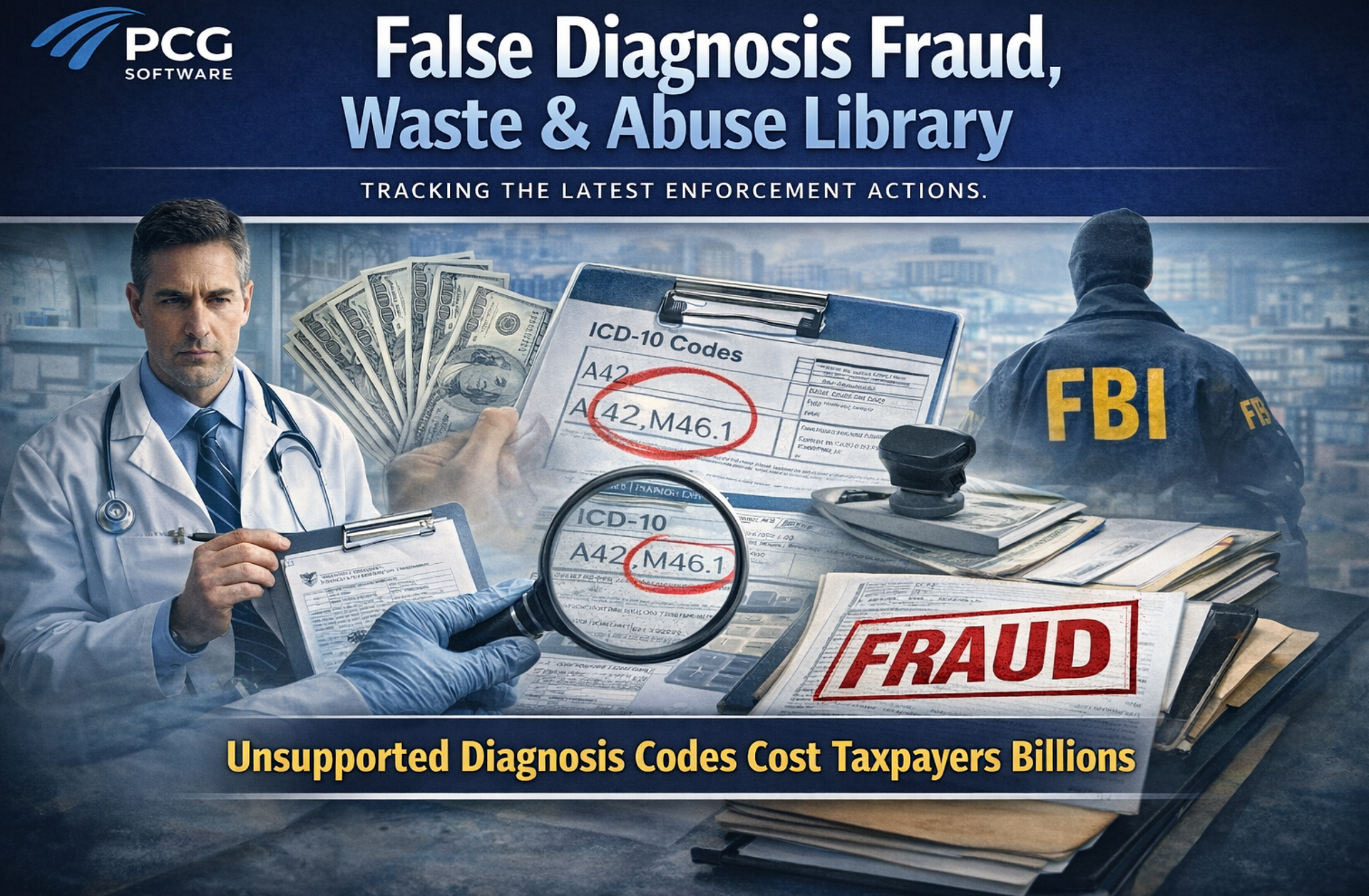
Medicare Advantage and similar programs reimburse insurers per member based on demographic factors and documented diagnoses. When providers or insurers add extra codes—often through retrospective chart reviews or physician pressure—risk scores increase, and CMS pays the plan more. The government has highlighted that inaccurate codes drive billions of dollars in overpayments and undermine the integrity of Medicare. In recent years, whistleblowers and government audits have exposed that some plans and providers upcoded conditions or fabricated diagnoses to boost revenue. The cases below illustrate how false diagnosis fraud occurs, the scale of settlements, and the enforcement focus on holding organizations accountable.
False Diagnsosis Fraud Cases
$62.85M – Seoul Medical Group - Mar 2025
The U.S. Department of Justice announced that Seoul Medical Group and its subsidiary Advanced Medical Management agreed to pay $58.74 million, their former president Dr. Min Young Cha agreed to pay $1.76 million, and Renaissance Imaging Medical Associates agreed to pay $2.35 million to resolve allegations they submitted false diagnosis codes for spinal conditions to inflate risk scores and increase payments for Medicare Advantage plan enrollees. From 2015 to 2021, clinicians working with Seoul’s network allegedly reported diagnoses of sacroiliitis and spinal enthesopathy that were not supported by patient records, and radiology reports were falsified to justify the codes. The scheme caused CMS to make higher monthly payments to Medicare Advantage plans. Under the settlement, the entities will enter a five‑year corporate integrity agreement, and the whistleblower will receive a share of the recovery..
Source:
DOJ Report
Action: Settlement, corporate integrity agreement and whistleblower award.
$98M – Independent Health Association & DxID – Dec 2024
Independent Health Association and its affiliate, Independent Health Corporation, agreed to pay up to $98 million to resolve allegations that they submitted invalid diagnosis codes to CMS to increase Medicare Advantage payments. The United States alleged that Independent Health’s subsidiary DxID performed retrospective chart reviews and queried physicians to add diagnoses not supported by beneficiaries’ medical records. This inflated risk scores and drove higher reimbursements from CMS. Under the settlement, Independent Health will make guaranteed payments of $34.5 million and contingent payments up to $63.5 million, while DxID’s founder Betsy Gaffney will pay $2 million. The plan must also implement a five‑year corporate integrity agreement requiring independent chart reviews.
Source:
DOJ Report
Action: Settlement, corporate integrity agreement, restitution and whistleblower share.
$10.25M – Oroville Hospital – Dec 2024
Oroville Hospital, a community hospital in California, agreed to pay $10.25 million to the United States and the State of California to resolve allegations that it paid kickbacks to physicians for inpatient admissions and submitted claims containing false diagnosis codes. The hospital allegedly provided bonuses to physicians based on inpatient admissions and billed Medicare and Medi‑Cal for medically unnecessary inpatient stays. Investigators also found that Oroville included false diagnosis codes for systemic inflammatory response syndrome (SIRS) on claims, resulting in excessive reimbursement. The settlement requires Oroville to enter a five‑year corporate integrity agreement with HHS‑OIG and includes an independent review organization to assess the medical necessity of claims.
Source:
DOJ Report
Action: Settlement, corporate integrity agreement and compliance review.
Breakdown of False Diagnosis Fraud Schemes

False Diagnosis Coding to Inflate Risk Scores
The cornerstone of risk adjustment fraud is the introduction of unsupported diagnoses into medical records. In the Seoul case, providers reported spinal conditions like sacroiliitis and spinal enthesopathy that were not actually diagnosed, while radiology reports were falsified to support the codes. In the Independent Health case, a wholly owned subsidiary, DxID, systematically searched patient charts and solicited physicians to add extra diagnoses without clinical basis. Oroville Hospital’s billing department allegedly inserted SIRS codes into claims for patients who did not meet the criteria. By inflating risk scores, these entities increased Medicare Advantage payments at the expense of taxpayers.
Kickbacks and Incentivized Admissions
False diagnosis schemes often intersect with illegal payment arrangements. Oroville Hospital paid bonuses to physicians based on the number of patients they admitted as inpatients, a structure that encouraged unnecessary hospital stays and created an opportunity to add false diagnoses. While the Seoul and Independent Health cases did not involve direct kickbacks, they show how providers and insurers profit by manipulating diagnosis coding rather than delivering appropriate care.
Background on Risk Adjustment and False Diagnoses
Medicare Advantage (Part C) risk adjustment pays plans a capitated rate per enrollee, adjusted for demographic factors and documented medical conditions. Diagnoses are coded using the International Classification of Diseases (ICD) and feed into hierarchical condition category (HCC) models. The greater the severity or number of diagnoses, the higher the risk score, and thus the higher the payment. CMS relies on providers and plans to report accurate diagnoses; it does not routinely review every chart. This system incentivizes accurate documentation but also opens the door to fraudulent coding when providers or insurers add conditions that are not supported by the medical record.
In addition, hospitals may receive higher payments for inpatient admissions compared with outpatient visits. When hospitals illegally pay bonuses to physicians for admissions, as alleged in the Oroville case, they create financial incentives to admit patients unnecessarily and to code them with more severe diagnoses.
Financial and Regulatory Impact
The settlements described here demonstrate the high stakes of false diagnosis fraud. Independent Health’s potential $98 million payment shows how risk adjustment fraud can yield settlements comparable to provider‑level kickback cases. Seoul Medical Group’s $62.85 million resolution underscores that health care providers and vendors—not just insurers—face liability for false diagnoses. Oroville Hospital’s $10.25 million settlement demonstrates that false diagnosis coding often accompanies other frauds, such as kickbacks and unnecessary admissions.
These cases also resulted in corporate integrity agreements requiring multi‑year compliance monitoring, independent chart reviews and risk assessments. Such agreements impose additional costs and operational changes on organizations. Whistleblowers received significant rewards, reinforcing the role of insiders in uncovering fraud.
Summary of Home Healthcare Fraud

Lessons for Payer Organizations
For Medicare Advantage organizations, TPAs, and other payers, the false diagnosis enforcement actions underscore the need for stronger front-end and ongoing controls. Payers should conduct proactive chart audits that compare diagnoses submitted to CMS against underlying medical records, with particular focus on high-weight HCCs and conditions known for elevated error rates. Oversight of third-party chart review vendors is critical; their practices must be evidence-based, fully documented, and supported by clear audit trails rather than driven by revenue targets. Compensation arrangements for physicians, coders, and vendors should be carefully reviewed to ensure they do not incentivize the addition of unsupported diagnoses or admissions volume. Investment in advanced analytics is essential to detect sudden spikes in risk scores, outlier coding behavior, or providers with unusually high prevalence of specific diagnoses. Finally, clinicians must be continuously educated on risk adjustment requirements, with clear reinforcement that every diagnosis must be supported by contemporaneous clinical evidence in the medical record.
Red Flags and Fraud Indications Warranting an Audit
False diagnosis fraud consistently presents identifiable warning signs that compliance teams should actively monitor. These include sudden increases in rare or highly weighted conditions—such as sacroiliitis, spinal enthesopathy, or sepsis/SIRS—across large patient panels without corresponding clinical justification. Diagnoses added retrospectively, rather than documented at the time of patient encounters, are another common indicator of manipulation. Delays or failures to produce supporting documentation when requested by auditors raise further concern, as do compensation structures that tie physician or coder pay to diagnosis volume or inpatient admissions. Patterns where identical diagnoses appear repeatedly across diverse patient populations may indicate templated documentation rather than individualized clinical assessment.
Enforcement Decisions and Actions
Recent enforcement actions demonstrate that false diagnosis fraud remains a top priority for the Department of Justice and HHS-OIG. Resolutions increasingly involve not only substantial financial penalties but also corporate integrity agreements that impose independent oversight and long-term compliance obligations. These cases also highlight the critical role of whistleblowers, whose disclosures triggered government investigations and resulted in significant relator awards. Prosecutors have made clear that accurate diagnosis coding is fundamental to Medicare program integrity, and that plans or providers who knowingly submit unsupported diagnoses should expect meaningful civil and criminal consequences.
Using AI Auditing to Prevent Home Healthcare Fraud
As false diagnosis schemes become more sophisticated, AI‑based auditing tools can transform how payers detect fraud. Platforms like Virtual Examiner® can analyze 100% of risk adjustment claims daily, cross‑checking reported diagnoses against clinical documentation, patient history and coding rules. By flagging anomalies—such as high‑value HCCs added through retrospective reviews or diagnoses unsupported by symptoms—AI can alert compliance teams before claims are submitted. Continuous monitoring also helps identify providers or vendors whose coding patterns deviate from peers. Implementing AI auditing reduces reliance on post‑payment sampling and reactive investigations, enabling payers to prevent fraud at the point of claim and ensure taxpayers’ dollars are spent on medically necessary care.
About PCG
For more than 30 years, PCG Software has helped health plans, provider organizations, and delegated entities improve coding accuracy, payment integrity, compliance, and fraud, waste, and abuse detection through payer-focused software and claims auditing expertise.
Click to share with others