CPT Code 96372: Injection Administration Billing and Documentation Guide
What is CPT Code 96372?
CPT code 96372 reports the administration of a therapeutic, prophylactic, or diagnostic injection delivered by the subcutaneous (SC) or intramuscular (IM) route. It does not describe the medication itself. In most cases, the drug administered is billed separately using the appropriate HCPCS Level II J-code, Q-code, or other applicable drug code. This distinction is one of the most common sources of billing errors and claim denials.
Because CPT 96372 is used across primary care, urgent care, orthopedics, rheumatology, endocrinology, pain management, and numerous other specialties, payers routinely review these claims for medical necessity, proper documentation, modifier usage, duplicate billing, and accurate reporting of both the administration service and the medication supplied.
| 96372 At a Glance | |
|---|---|
| CPT Code | 96372 |
| Service | Therapeutic, prophylactic, or diagnostic injection administration |
| Route | Subcutaneous (SC) or Intramuscular (IM) |
| Medication Included? | No |
| Medication Billed Separately? | Usually yes |
| Global Period | XXX |
| CMS MUE | 4 |
| Common Places of Service | Office, Outpatient Hospital, Independent Clinic |
AMA Definition vs. Plain Language
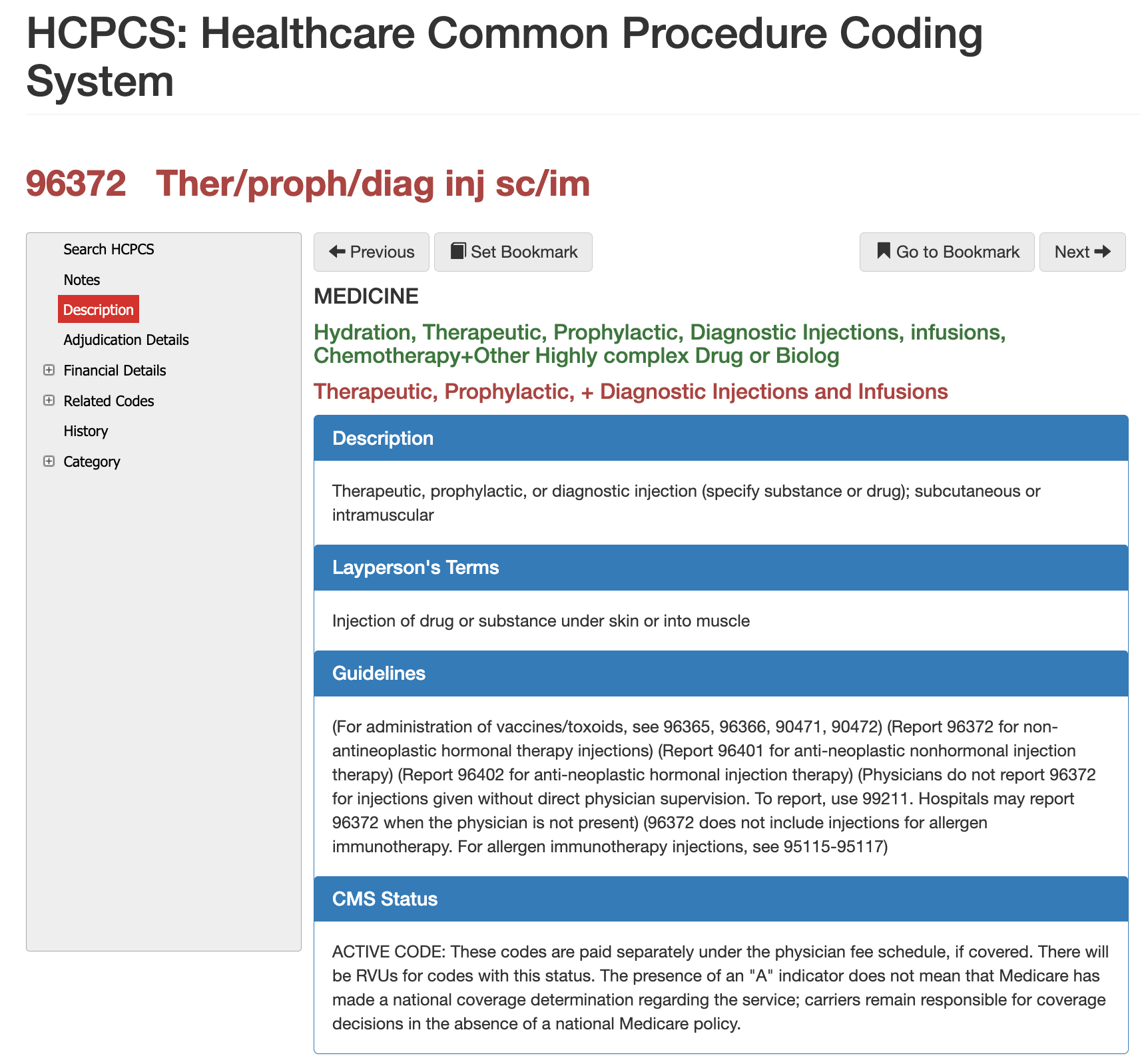
AMA Description:
Therapeutic, prophylactic, or diagnostic injection (specify substance or drug); subcutaneous or intramuscular.
In Plain English
CPT 96372 represents the work involved in administering a medication by injection beneath the skin or into a muscle. It reimburses the administration service—not the medication itself.
For example, if a physician administers an intramuscular injection of ceftriaxone for a bacterial infection, the claim generally includes:
- CPT 96372 for administering the injection.
- The appropriate HCPCS drug code for the ceftriaxone supplied.
Virtual AuthTech® classifies CPT 96372 within the Medicine section under therapeutic, prophylactic, and diagnostic injections and identifies it as an active Physician Fee Schedule service.
Coding Tip: The Most Common Billing Mistake
One of the most frequent coding errors involving CPT 96372 is assuming the code represents both the injection and the medication. It does not.
Think of CPT 96372 as paying for the act of administering the injection. The administered medication is typically reported separately, with the appropriate HCPCS drug code.
For example:
- 96372 → Administration of the injection
- J0696 → Ceftriaxone supplied
- J1885 → Ketorolac supplied
- J3420 → Vitamin B12 supplied
- Missing either component may result in payment delays, manual review, or claim denial depending on payer policy.
When to Bill CPT Code 96372
CPT 96372 is reported when a therapeutic, prophylactic, or diagnostic medication is administered by the subcutaneous or intramuscular route under the appropriate level of provider supervision.
Common examples include:
- Intramuscular antibiotics
- Corticosteroid injections
- Vitamin B12 therapy
- Testosterone replacement
- Osteoporosis medications
- Migraine medications
- Certain biologic therapies
- Hormone injections
- Anti-inflammatory medications
- Long-acting psychiatric medications
Documentation should clearly identify:
- The medication administered
- Route of administration
- Dosage
- Injection site when appropriate
- Ordering provider
- Diagnosis supporting medical necessity
When Not to Bill CPT Code 96372
CPT 96372 should not be reported simply because a patient received an injection. Other CPT codes may more accurately describe the service, including:
- Vaccine administration
- Intravenous push services
- IV infusion therapy
- Chemotherapy administration
- Highly complex biologic infusions
- Injection services bundled into another procedure under National Correct Coding Initiative (NCCI) rules.
Selecting the incorrect administration code is a common cause of denials and post-payment audits.
Real-World Claims Scenarios for 96372 CPT
Scenario 1: Family Medicine
A patient presents with community-acquired pneumonia. After evaluation, the physician orders an intramuscular ceftriaxone injection before discharge.
The claim may include:
Appropriate Evaluation and Management (E/M) service, when separately reportable
CPT 96372 for administering the injection
HCPCS drug code for ceftriaxone
A common billing error is reporting only CPT 96372 while failing to bill the medication supplied.
Scenario 2: Orthopedic Practice
A patient with acute lumbar pain receives an intramuscular ketorolac (Toradol) injection after a medically necessary office evaluation.
Because the physician performed a significant, separately identifiable E/M service, the office visit may qualify for Modifier 25, while CPT 96372 reports the injection administration and the HCPCS drug code reports the medication.
Modifier 25 applies to the E/M service—not to CPT 96372.
Scenario 3: Endocrinology
A patient with pernicious anemia receives a scheduled monthly vitamin B12 injection.
If documentation supports medical necessity and identifies the medication administered, reporting CPT 96372 with the appropriate HCPCS code for cyanocobalamin is generally appropriate.
Medical Necessity Requirements for CPT Code 96372
Medical necessity extends beyond documenting that an injection was given. The medical record should explain why injectable therapy was clinically appropriate.
Common conditions supporting CPT 96372 include:
- Vitamin deficiencies
- Hormone replacement therapy
- Acute bacterial infections
- Migraine treatment
- Chronic inflammatory disorders
- Rheumatoid arthritis
- Osteoporosis
- Pain management
- Endocrine disorders
- Autoimmune diseases
Many commercial payers also review whether injectable therapy was appropriate based on the patient's diagnosis, treatment history, and accepted standards of care.
Claims reviewers frequently compare:
- Diagnosis code
- Medication administered
- HCPCS drug code
- Route of administration
- Units billed
- Supporting clinical documentation
When these elements do not align, the claim is more likely to be denied or selected for manual review.
Documentation Requirements
Complete documentation is essential for accurate reimbursement and audit readiness. A compliant medical record should generally include:
- Chief complaint
- Diagnosis supporting treatment
- Medication name
- Drug strength
- Dose administered
- Route of administration (SC or IM)
- Injection site when clinically appropriate
- Ordering provider
- Individual administering the injection
- Date of service
- Patient response when medically relevant
If the practice supplies the medication, documentation should also support the HCPCS drug code and the number of units billed.
One of the most common documentation deficiencies identified during payment integrity reviews is the failure to clearly connect the patient's diagnosis to the medication administered. Even when the injection is properly documented, missing or unsupported medical necessity may result in denial.
Related Codes for 96372
Selecting the correct drug administration code is just as important as documenting the medication itself. Although CPT 96372 is commonly used for subcutaneous and intramuscular injections, many administration services are reported under entirely different CPT codes based on the route of administration, the complexity of the service, and the type of medication delivered.
Understanding these distinctions helps providers avoid denials and payers identify incorrect code selection during pre- and post-payment reviews.
| CPT Code | Description | When to Use |
|---|---|---|
| 96372 | Therapeutic, prophylactic, or diagnostic injection (SC or IM) | Standard subcutaneous or intramuscular medication administration |
| 90471 | Vaccine administration | Immunizations and vaccines |
| 96365 | Initial intravenous infusion | Therapeutic IV infusions lasting more than 15 minutes |
| 96374 | Intravenous push | Medications administered by IV push |
| 96401 | Chemotherapy, hormone therapy, or biologic administration (SC/IM) | Certain chemotherapy and highly complex biologic agents |
One of the most common coding errors is reporting CPT 96372 when another administration code more accurately reflects the service provided. Selecting the correct administration code depends on the medication, route, and clinical circumstances—not simply the fact that an injection occurred.
Can CPT 96372 Be Reported with an Office Visit?
Yes—but not automatically.
Providers often administer injections during an Evaluation and Management (E/M) visit. However, the office visit is separately reportable only when the physician performs a significant, separately identifiable evaluation beyond deciding to administer the injection.
Appropriate Example
A patient presents with worsening low back pain. The physician performs a comprehensive history, physical examination, reviews imaging, develops a treatment plan, and decides to administer an intramuscular ketorolac injection.
The claim may include:
- Appropriate E/M service
- Modifier 25 appended to the E/M code
- CPT 96372
- Appropriate HCPCS drug code
Inappropriate Example
A patient arrives for a previously scheduled monthly vitamin B12 injection. Nursing staff administers the medication according to an existing physician order.
Because no separately identifiable physician evaluation occurred, billing both an office visit and CPT 96372 would generally not be appropriate.
Modifier 25 remains one of the most frequently audited modifiers associated with injection administration services.
Can Multiple 96372 Injections Be Reported on the Same Day?
Sometimes.
Receiving multiple injections during the same encounter does not automatically justify reporting multiple units of CPT 96372.
Claims reviewers typically consider:
- Were separate medications administered?
- Were separate injections medically necessary?
- Were multiple anatomical sites used?
- Does payer policy allow multiple administrations?
- Does documentation support each administration?
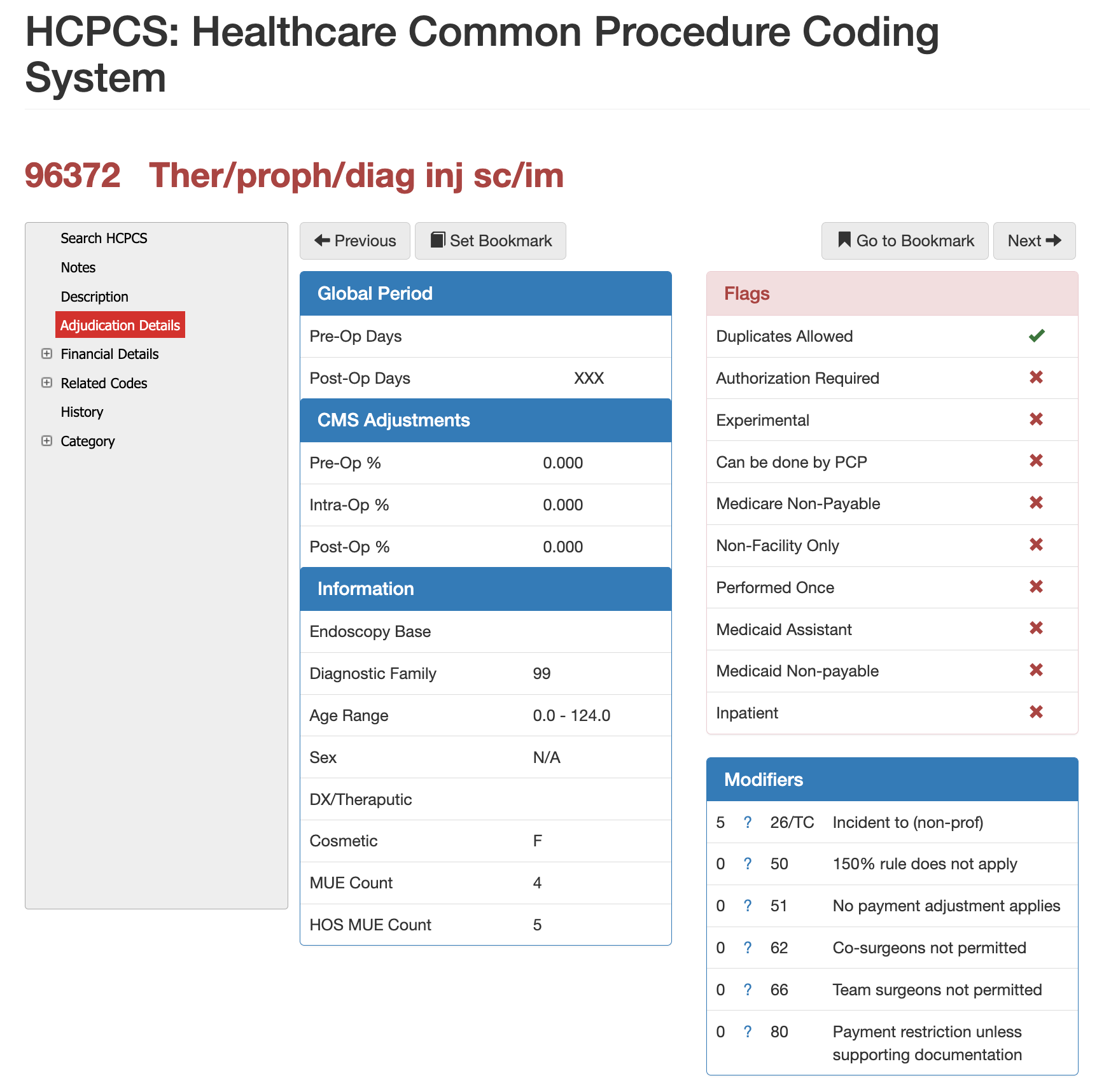
Virtual AuthTech® identifies a Medically Unlikely Edit (MUE) value of 4, meaning Medicare generally limits reporting to four medically appropriate administrations per date of service before additional review may occur.
Suggested Screenshot: Adjudication Details
Providers should always verify payer-specific billing policies, as commercial carriers may apply different frequency edits.
Modifier Guidance for CPT 96372
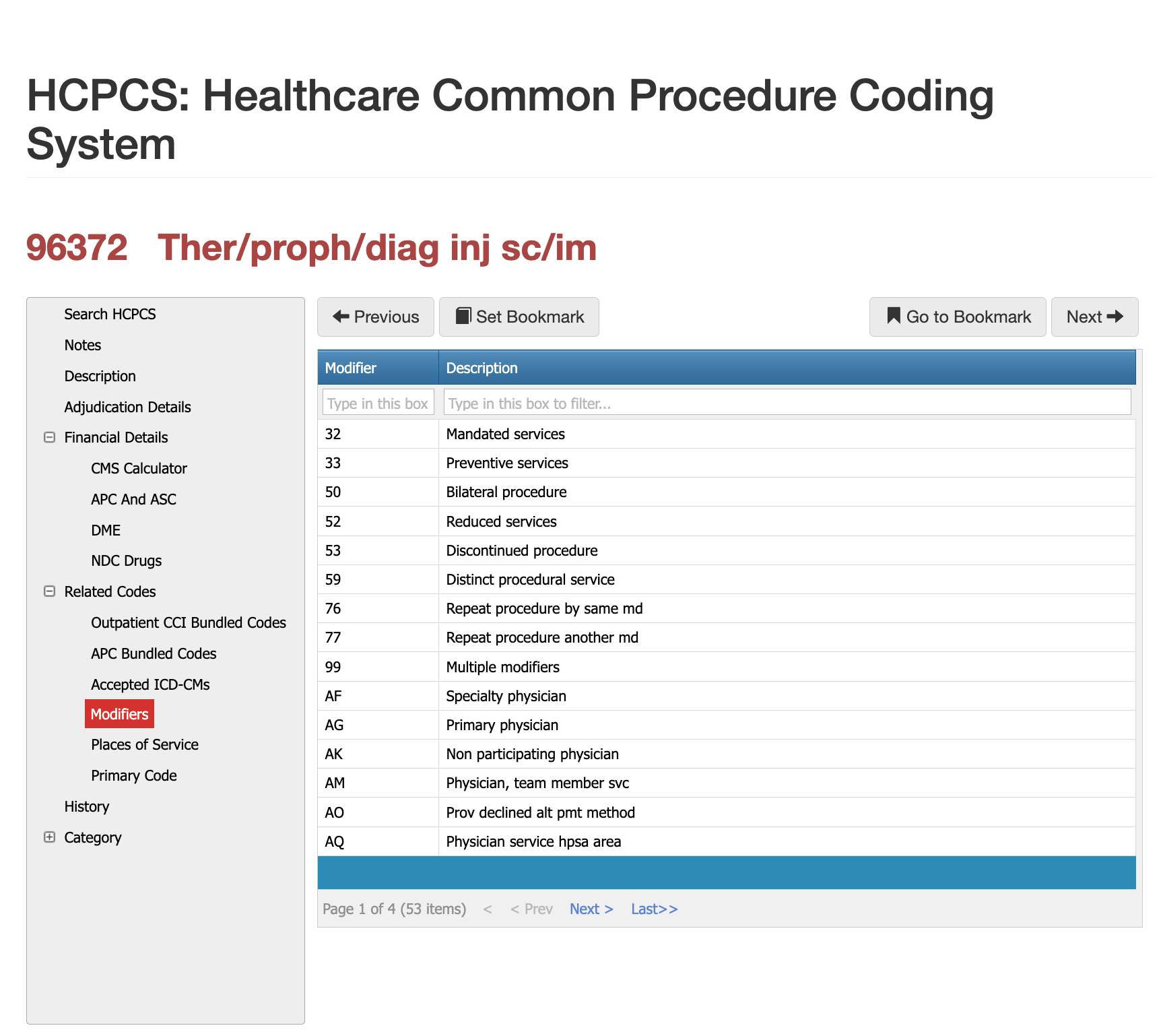
Modifier selection depends on the circumstances surrounding the injection rather than the medication itself. Virtual AuthTech® identifies several modifiers that may apply depending on payer policy and clinical documentation.
Modifier 25 with 96372?
Used when a significant, separately identifiable E/M service is performed on the same day as the injection.
This modifier is applied to the office visit, not CPT 96372.
Modifier 59 with 96372?
May be appropriate when documentation supports a distinct procedural service that would otherwise be bundled.
Improper use of Modifier 59 remains a frequent target of payer audits and should be supported by clear documentation.
Modifier 76 with 96372?
Indicates a repeat procedure performed by the same physician when supported by medical necessity.
*** Make sure your documentation states why this is necessary or you'll face an audit.
Modifier 77 with 96372?
Indicates the repeat procedure was performed by a different physician or qualified healthcare professional.
*** Document why another provider was needed to perform this procedure to remain compliant.
Modifier 91 with 96372?
Generally not appropriate for CPT 96372 because Modifier 91 applies to repeat clinical laboratory testing rather than injection administration.
Telehealth Modifiers and 96372?
Because CPT 96372 represents an in-person injection administration service, telehealth modifiers generally do not apply to the administration itself.
Common Billing Errors with 96372
Injection administration appears straightforward, yet CPT 96372 generates a surprising number of denials because of avoidable billing mistakes.
The most common include:
- Billing the injection administration without reporting the medication supplied.
- Billing the medication without documenting its administration.
- Reporting the wrong administration code.
- Billing vaccine administration using CPT 96372.
- Reporting duplicate injection administrations.
- Missing or unsupported medical necessity.
- Billing an E/M visit without documentation supporting Modifier 25.
- Incorrect HCPCS drug units.
- Failure to document the administration route.
- Incorrect diagnosis-to-medication relationship.
Many of these errors are identified during automated claims editing before payment is issued.
National Correct Coding Initiative (NCCI) Considerations
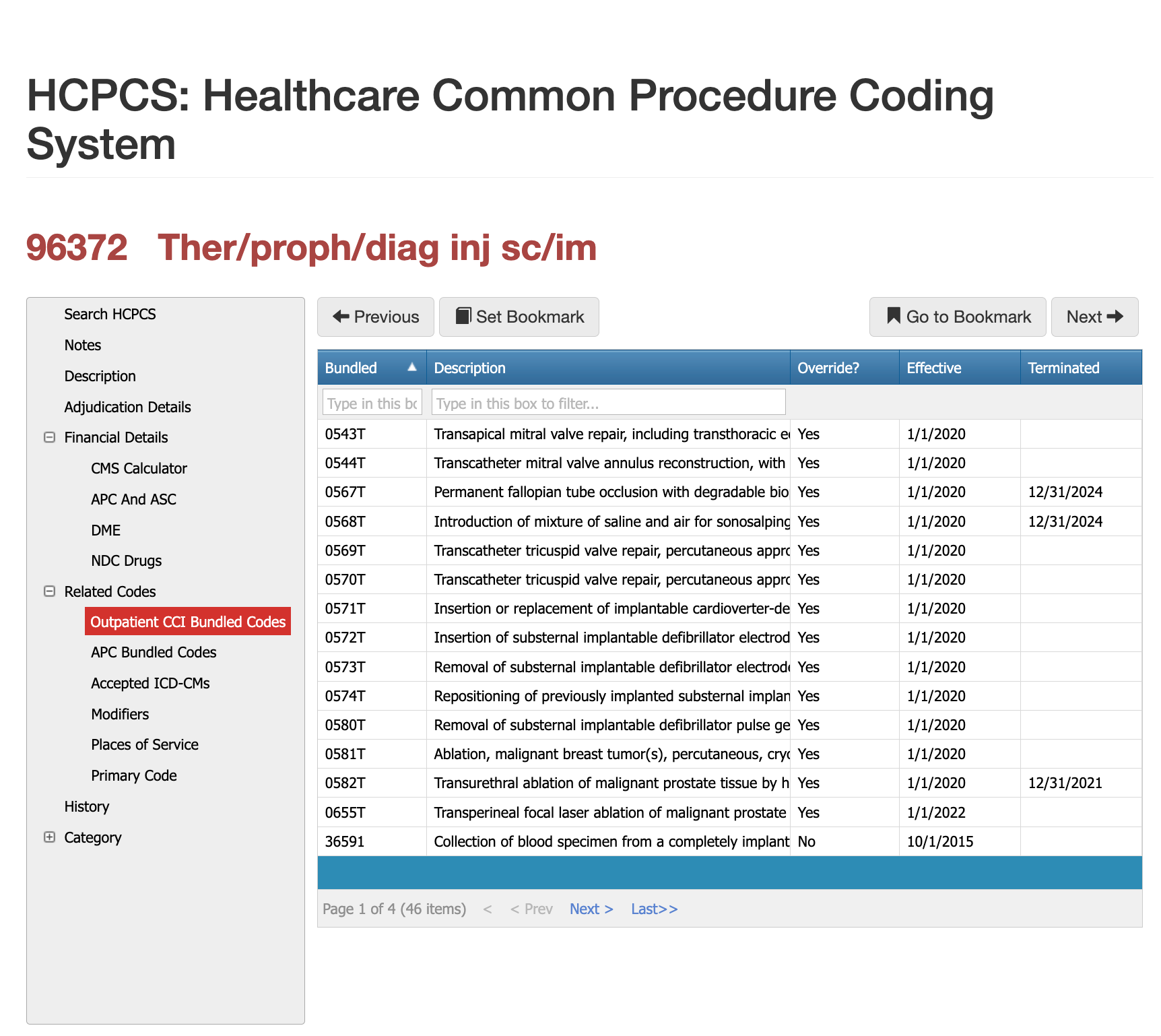
The National Correct Coding Initiative (NCCI) establishes code-pair edits to prevent inappropriate unbundling of services considered integral to one another. Virtual AuthTech® identifies numerous outpatient CCI relationships involving CPT 96372.
Claims reviewers commonly evaluate whether:
- Injection administration is separately payable.
- Another procedure already includes the administration.
- Modifier usage appropriately bypasses an edit.
- Separate documentation supports distinct services.
Improperly bypassing NCCI edits with unsupported modifiers may result in payment recoupments, compliance findings, or False Claims Act exposure in cases of repeated improper billing.
APC and ASC Payment Considerations
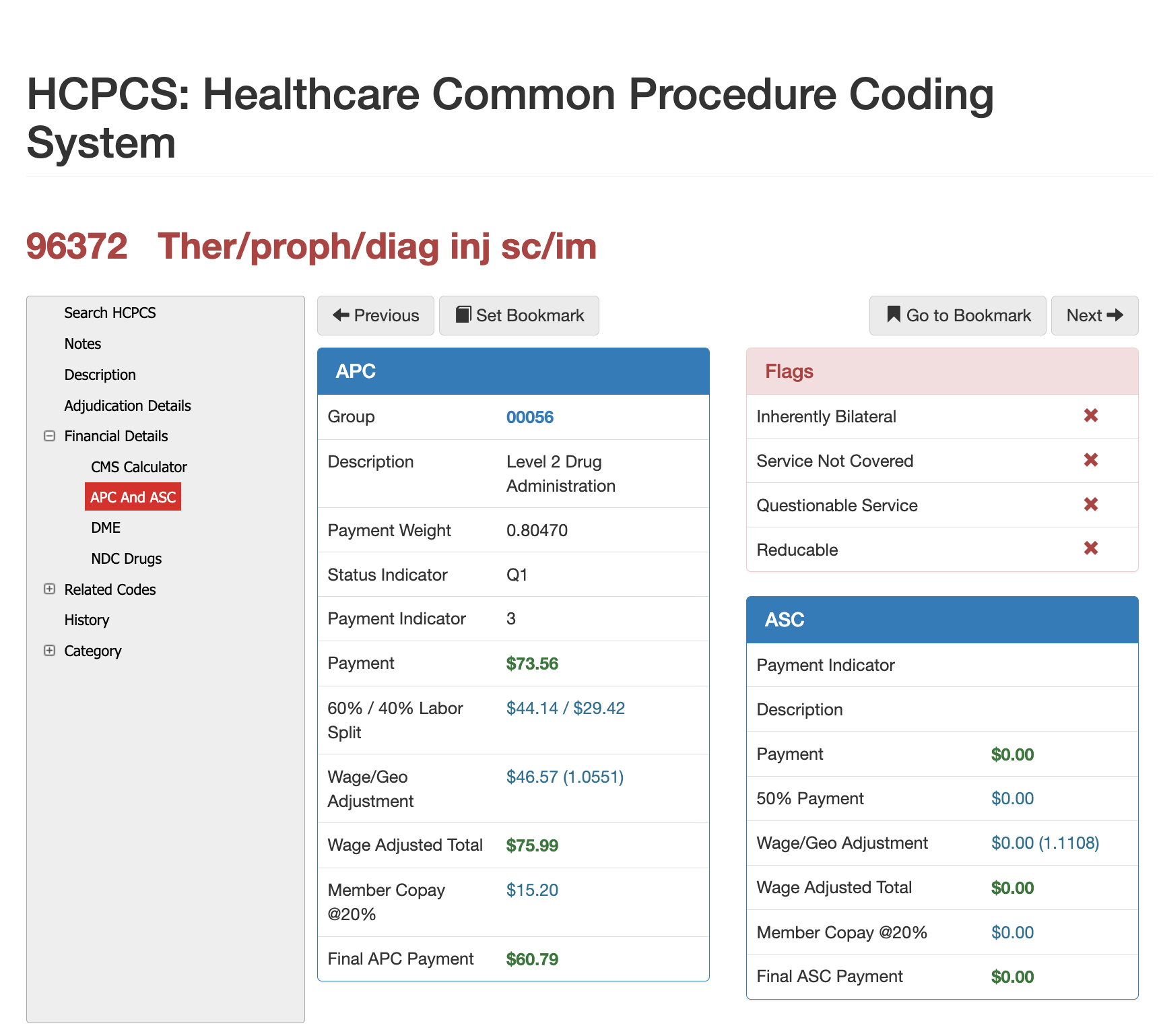
Hospital outpatient departments are reimbursed under the Medicare Outpatient Prospective Payment System (OPPS), where CPT 96372 is assigned to an Ambulatory Payment Classification (APC).Virtual AuthTech® identifies CPT 96372 within:
- APC Group information
- APC Status Indicator
- Relative Payment Weight
- National Payment Rate
- ASC payment relationships
Hospital billing departments should verify that outpatient claims comply with current APC packaging rules and applicable status indicators, as payment methodologies may differ from those used in physician offices.
Medicare Reimbursement Considerations for 96372
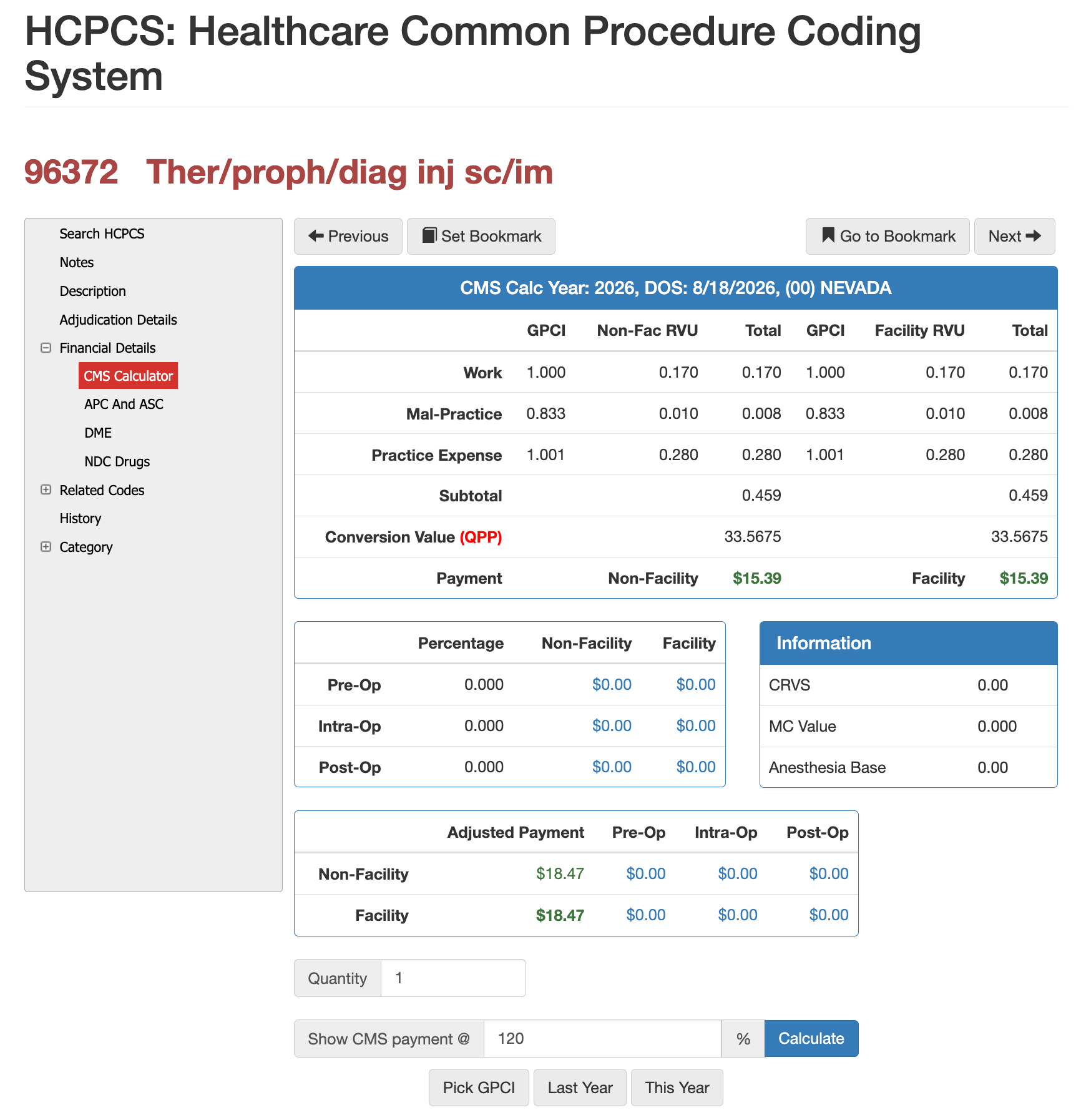
Virtual AuthTech® provides reimbursement intelligence that extends beyond the annual Medicare Physician Fee Schedule. The image below represents the state of Nevada for 2026 and compares 96372 RVUs at 100% and 120% to Medicare. In VA, you can choose a percentage at the bottom to calculate rates based on your GPCI. Additionally, Users can review:
- Work RVUs
- Practice Expense RVUs
- Malpractice RVUs
- Geographic Practice Cost Index (GPCI)
- Non-Facility Payment
- Facility Payment
- Historical reimbursement changes
Because Medicare updates reimbursement annually, organizations should verify current payment values using the applicable Physician Fee Schedule while also considering local contractor guidance and payer-specific policies.
Historical Coding and Reimbursement Changes
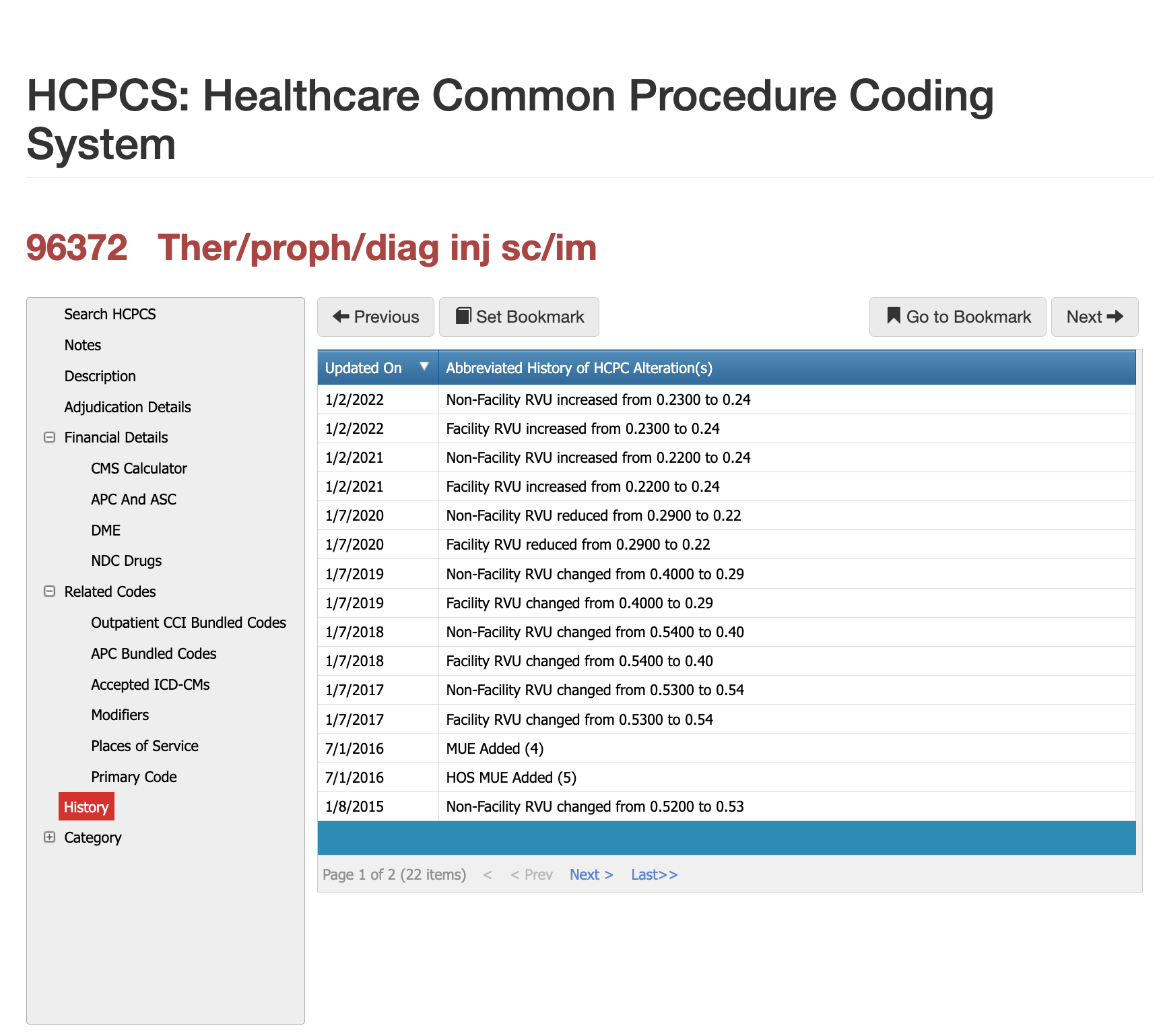
Like many CPT codes, reimbursement and payment rules for CPT 96372 have evolved over time as CMS updates Relative Value Units (RVUs), physician fee schedules, and outpatient payment methodologies. Virtual AuthTech® allows users to review historical reimbursement data for CPT 96372, including:
- Annual RVU changes
- Physician Fee Schedule updates
- Medicare payment trends
- Historical reimbursement values
- APC payment modifications
- CMS rule changes affecting reimbursement
Understanding these historical changes helps providers, coders, and payment integrity teams identify reimbursement trends while ensuring claims are submitted using the most current payment methodologies.
Frequently Asked Questions about CPT Code 96372
Does CPT 96372 include the medication?
No. CPT 96372 reports only the administration of a therapeutic, prophylactic, or diagnostic injection. The medication itself is generally billed separately using the appropriate HCPCS Level II drug code.
Can CPT 96372 be billed with an office visit?
Yes, but only when the physician performs a significant, separately identifiable Evaluation and Management (E/M) service beyond the work associated with administering the injection. When appropriate, Modifier 25 is appended to the E/M code—not CPT 96372.
Can multiple units of CPT 96372 be billed on the same day?
Sometimes. Multiple administrations may be appropriate when separate medically necessary injections are administered and fully documented. Medicare's Medically Unlikely Edit (MUE) and individual payer policies should always be considered before reporting multiple units.
Is prior authorization required for 96372?
The injection administration itself rarely requires prior authorization. However, many injectable medications—including biologics, specialty drugs, and certain high-cost therapies—may require prior authorization depending on the payer and line of business.
Can nurses bill CPT 96372?
Qualified clinical staff may administer injections under applicable supervision requirements, but billing is submitted under the supervising physician or qualified healthcare professional according to payer policy and applicable incident-to or facility billing rules.
Is CPT 96372 used for vaccines?
No. Vaccine administration is reported using the immunization administration code set (90471–90474) rather than CPT 96372.
Can CPT 96372 be billed without a drug code?
Although payer policies vary, reporting CPT 96372 without documenting and, when applicable, billing the medication supplied frequently results in claim edits, medical record requests, or denials.
96372 Audit Checklist
Although CPT 96372 is a relatively low-complexity procedure, it is billed millions of times each year, making it a high-volume target for both automated claims-editing systems and payment-integrity programs. Health plans, Medicare contractors, and recovery auditors commonly review claims involving:
- Duplicate injection administrations
- Unsupported Modifier 25 usage
- Missing HCPCS drug codes
- Incorrect HCPCS units
- Administration without documentation
- Vaccine miscoding
- Improper unbundling
- Diagnosis-to-drug mismatches
- Repeated administration services
- Incomplete medical necessity
Even small documentation deficiencies can lead to payment delays, additional documentation requests, or post-payment recoupments when identified across large claim volumes.
Before submitting a claim, providers, coders, and billing teams should verify:
✓ The medication administered is documented.
✓ The correct HCPCS drug code is reported when applicable.
✓ The diagnosis supports medical necessity.
✓ The route of administration was subcutaneous or intramuscular.
✓ The dosage and units are documented.
✓ The administration code matches the service performed.
✓ Modifier 25 is supported by a separately identifiable E/M service.
✓ Documentation supports any additional modifiers used.
✓ The Place of Service matches where the injection occurred.
✓ National Correct Coding Initiative (NCCI) edits have been reviewed before overriding any bundling edits.
A standardized review process helps reduce denials while improving coding consistency and audit readiness.
Key Takeaways
CPT code 96372 reports the administration of a therapeutic, prophylactic, or diagnostic medication by subcutaneous or intramuscular injection. It does not include the medication itself, which is typically billed separately using the appropriate HCPCS drug code.
Accurate reimbursement depends on selecting the correct administration code, documenting medical necessity, reporting the appropriate drug and dosage, applying modifiers correctly, and complying with Medicare, commercial payer, and National Correct Coding Initiative (NCCI) requirements.
Because injection administration services are among the most frequently billed procedures in outpatient medicine, even minor coding or documentation errors can create significant financial and compliance risk when repeated across large patient populations. Providers and billing professionals who consistently document the medication administered, the route of administration, the supporting diagnosis, and any separately identifiable Evaluation and Management services are better positioned to reduce denials, improve payment accuracy, and withstand payer audits.
Whether you are a physician, coder, auditor, revenue cycle specialist, or payment integrity professional, understanding the billing and reimbursement requirements for CPT 96372 is essential to maintaining compliance while optimizing reimbursement in today's increasingly scrutinized healthcare environment.
About PCG
For more than 30 years, PCG Software has helped health plans, provider organizations, and delegated entities improve coding accuracy, payment integrity, compliance, and fraud, waste, and abuse detection through payer-focused software and claims auditing expertise.
Click to share with others