

CPT Code 73721 - Radiology Imaging Coding Tips
Quick Summary of CPT Code 73721
CPT code 73721 describes an MRI of a lower extremity joint performed without contrast material. This diagnostic imaging code is commonly used for evaluating the knee, ankle, hip, or other lower-extremity joints when providers suspect ligament tears, meniscus injuries, cartilage damage, inflammation, chronic pain, or internal derangement. Because MRI technology provides detailed soft tissue imaging without radiation exposure, CPT 73721 is frequently ordered before surgery, after failed conservative treatment, or when X-rays do not fully explain a patient’s symptoms.
From a claims and coding perspective, payers carefully review CPT 73721 for medical necessity, authorization requirements, diagnosis support, duplicate imaging, modifier usage, and proper site-of-service billing. Incorrect documentation or unsupported diagnoses are common reasons for denials or post-payment audits.
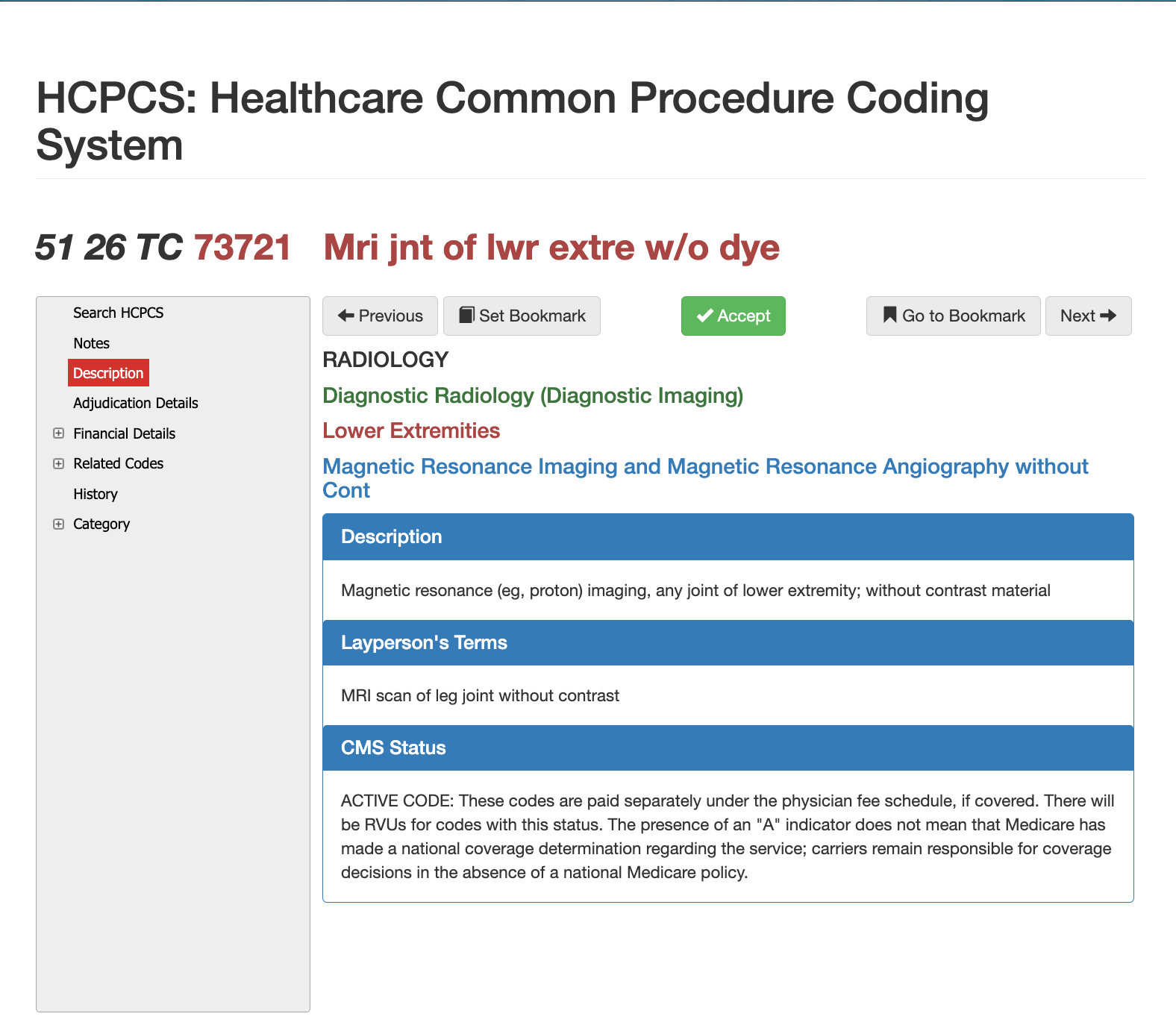
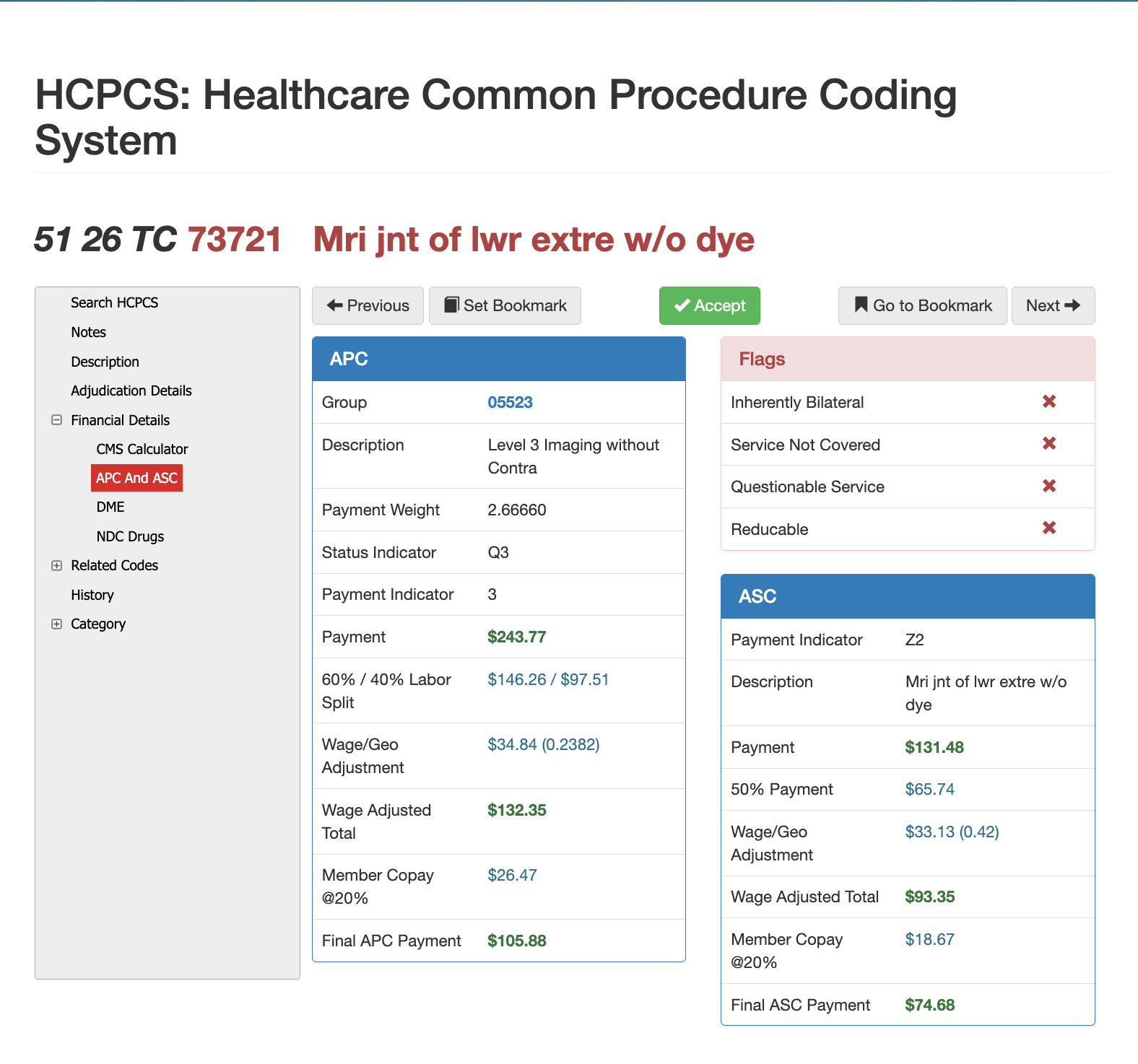
The Who, What, When for billing and paying for CPT Code 73721
Definition of CPT Code 73721 - AMA vs Layperson:
“Magnetic resonance (eg, proton) imaging, any joint of lower extremity; without contrast material.”
In plain language, CPT 73721 is an MRI scan of a lower-body joint without using injected contrast dye. The scan is designed to help providers identify injuries or abnormalities involving muscles, tendons, ligaments, cartilage, bone marrow, and joint structures.
This code is most commonly associated with:
- Knee MRI
- Hip MRI
- Ankle MRI
- Foot joint MRI
Claims reviewers examine whether the imaging was medically necessary and whether conservative treatment or prior imaging supported the need for advanced diagnostic testing.
When is CPT Code 73721 Used?
CPT 73721 is used when a provider needs detailed imaging of a lower extremity joint without contrast enhancement. It is frequently ordered for:
- Chronic joint pain
- Meniscus tears
- ACL or ligament injuries
- Joint instability
- Swelling or inflammation
- Suspected cartilage damage
- Sports injuries
- Degenerative joint disease
- Failed conservative therapy
Providers must clearly document:
- The affected joint
- Clinical symptoms
- Failed prior treatment
- Why is an MRI medically necessary
- Why was contrast not required
Many payers require prior authorization before approving advanced imaging services, such as MRI studies.
Claims reviewers verify that the documentation supports:
- Medical necessity
- Appropriate diagnosis coding
- Correct extremity and anatomical site
- Failure of conservative treatment when required
- Proper authorization approval
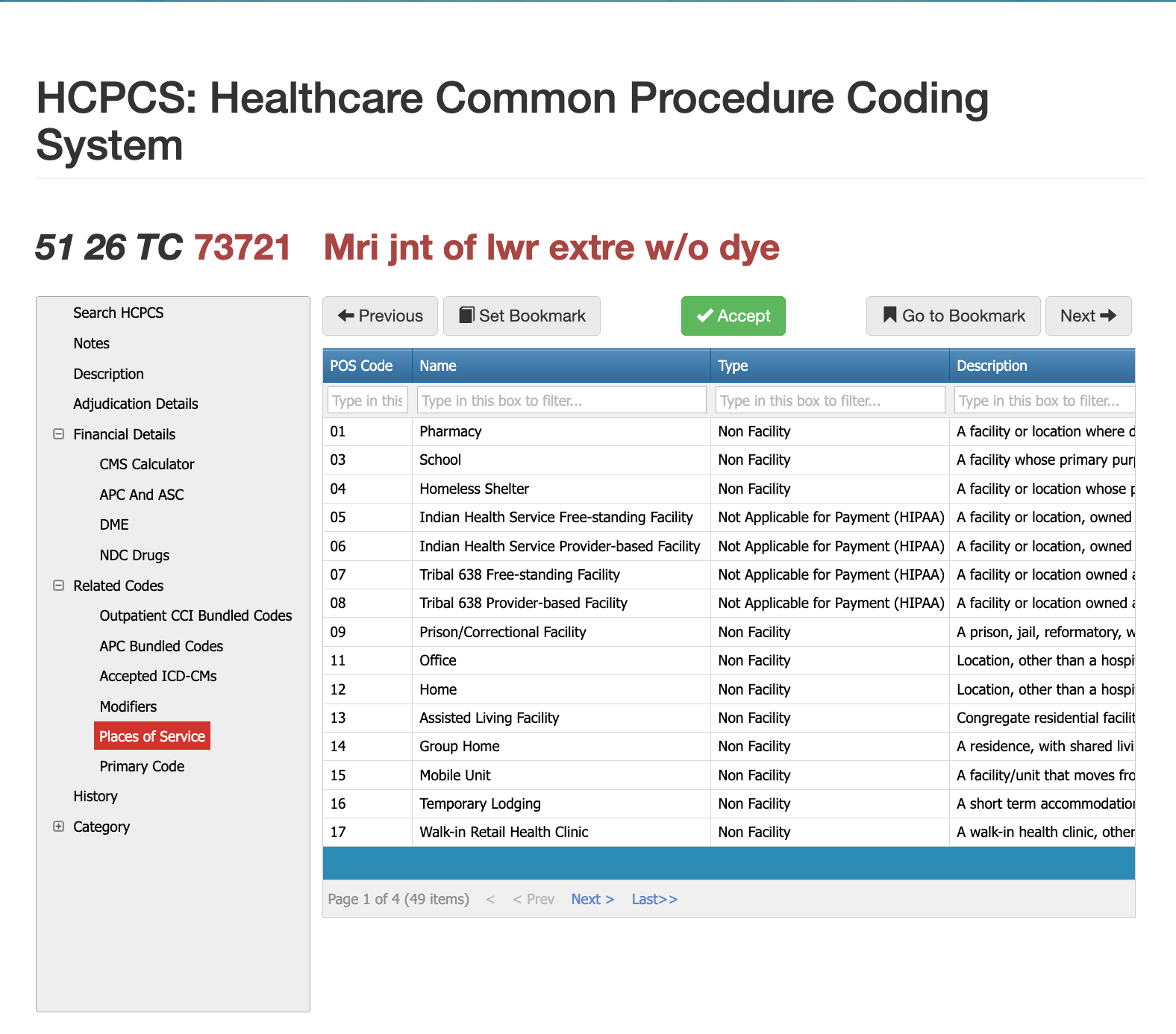
Places of Service for CPT Code 73721
Virtual AuthTech® identifies multiple applicable Places of Service (POS) for CPT 73721, including:
- POS 11 – Office
- POS 22 – Outpatient Hospital
- POS 24 – Ambulatory Surgical Center
- POS 49 – Independent Clinic
MRI procedures are commonly performed in:
- Imaging centers
- Hospital outpatient departments
- Orthopedic clinics
- Radiology facilities
Claims examiners verify that:
- The POS supports advanced imaging
- Authorization matches the service location
- Facility billing aligns with CMS rules
Proper Documentation for CPT Code 73721
To support CPT 73721, the medical record should include:
- Patient symptoms
- Joint-specific complaints
- Physical examination findings
- Conservative treatment history
- Prior imaging results if applicable
- Ordering provider rationale
- Final radiology interpretation
Documentation should clearly identify:
- Which joint was imaged
- Why was the contrast unnecessary
- Clinical indication for MRI
- Duration of symptoms
- Functional impairment
Common denial triggers include:
- Missing medical necessity
- Unsupported diagnoses
- Lack of failed conservative therapy
- Duplicate imaging studies
- Authorization mismatch
- Incorrect anatomical coding
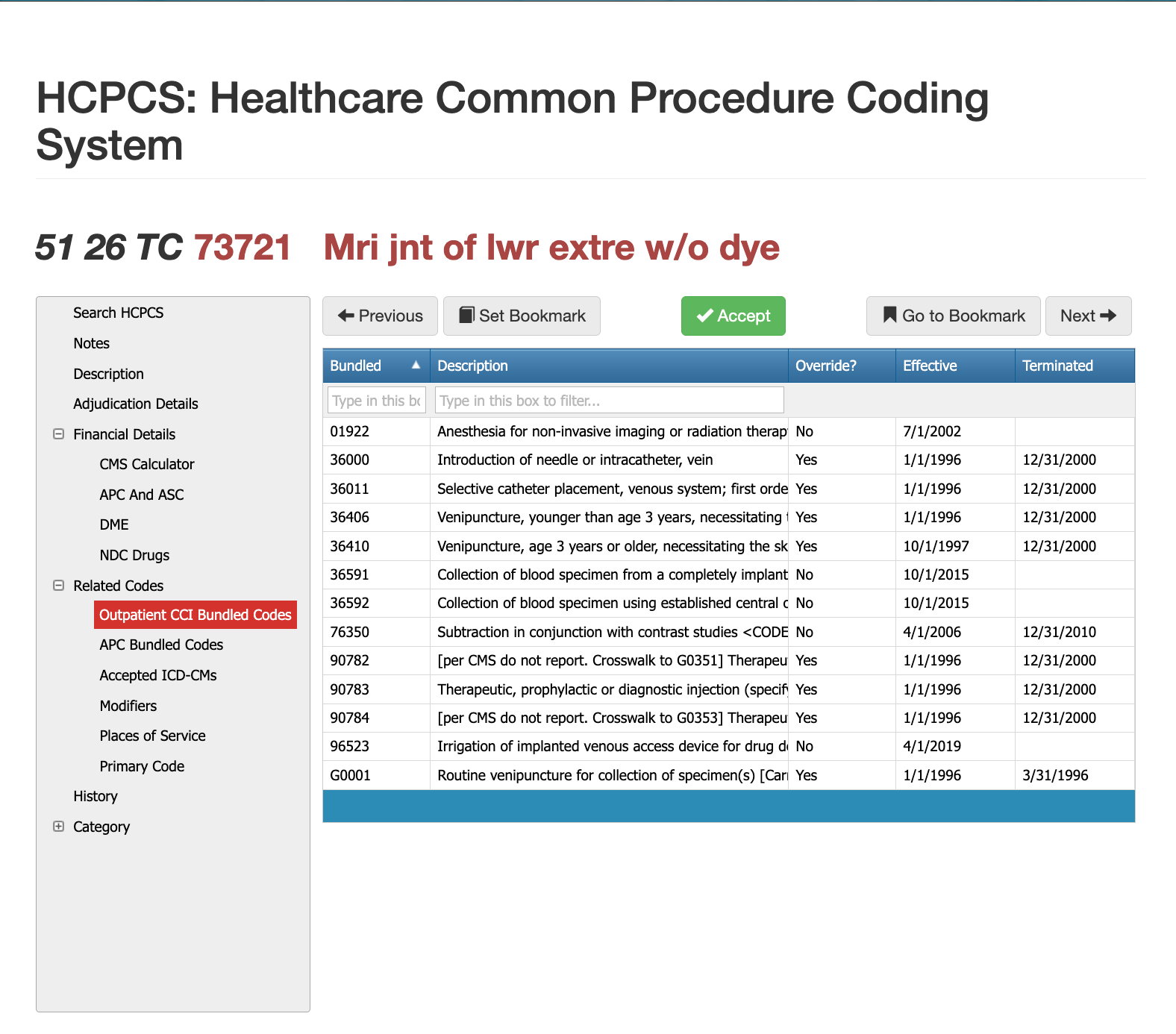
Related CPT Codes for 73721
Virtual AuthTech® identifies multiple outpatient bundled code relationships associated with CPT 73721.
Examples shown within the platform include:
- Venipuncture services
- Catheter placement procedures
- Contrast administration relationships
- Ancillary imaging support services
Payers often review:
- Duplicate imaging
- Unbundling attempts
- Incorrect separate billing
- Technical component overlap
Improper imaging combinations can trigger:
- NCCI edits
- APC reductions
- Payment recoupments
- Medical necessity audits
| Code | Description | Difference |
|---|---|---|
| 73718 | MRI lower extremity without contrast | Non-joint imaging |
| 73719 | MRI lower extremity with contrast | Contrast required |
| 73720 | MRI lower extremity with and without contrast | Combined imaging |
| 73722 | MRI joint lower extremity with contrast | Joint-specific with contrast |
| 73723 | MRI joint lower extremity with and without contrast | Joint imaging with combined contrast study |
Modifier 26 – Professional Component
Used when billing only the physician interpretation of the MRI.
Modifier TC – Technical Component
Used when billing only the imaging equipment, technician, and facility portion.
Modifier 51 – Multiple Procedures
Special imaging reduction rules may apply when multiple imaging procedures are performed during the same encounter. CMS imaging reduction rules may decrease reimbursement for secondary procedures.
Modifier 80
Assistant surgeon restrictions may apply, and supporting documentation may be required.
Claims reviewers frequently audit MRI claims for improper modifier combinations, especially when global billing and component billing overlap.
Most Common Reasons for 20220 CPT Denials
Payers frequently deny CPT 73721 for:
- Missing prior authorization
- Unsupported medical necessity
- Incomplete documentation
- Wrong anatomical site
- Incorrect modifier usage
- Duplicate imaging
- Failure to document conservative treatment
- Diagnosis mismatch
- Billing global and component services incorrectly
Many commercial plans require:
- Physical therapy first
- X-ray imaging before MRI
- Conservative treatment documentation
- Orthopedic evaluation
Claims may also be denied when providers order MRI studies too early without demonstrating failed lower-cost interventions.
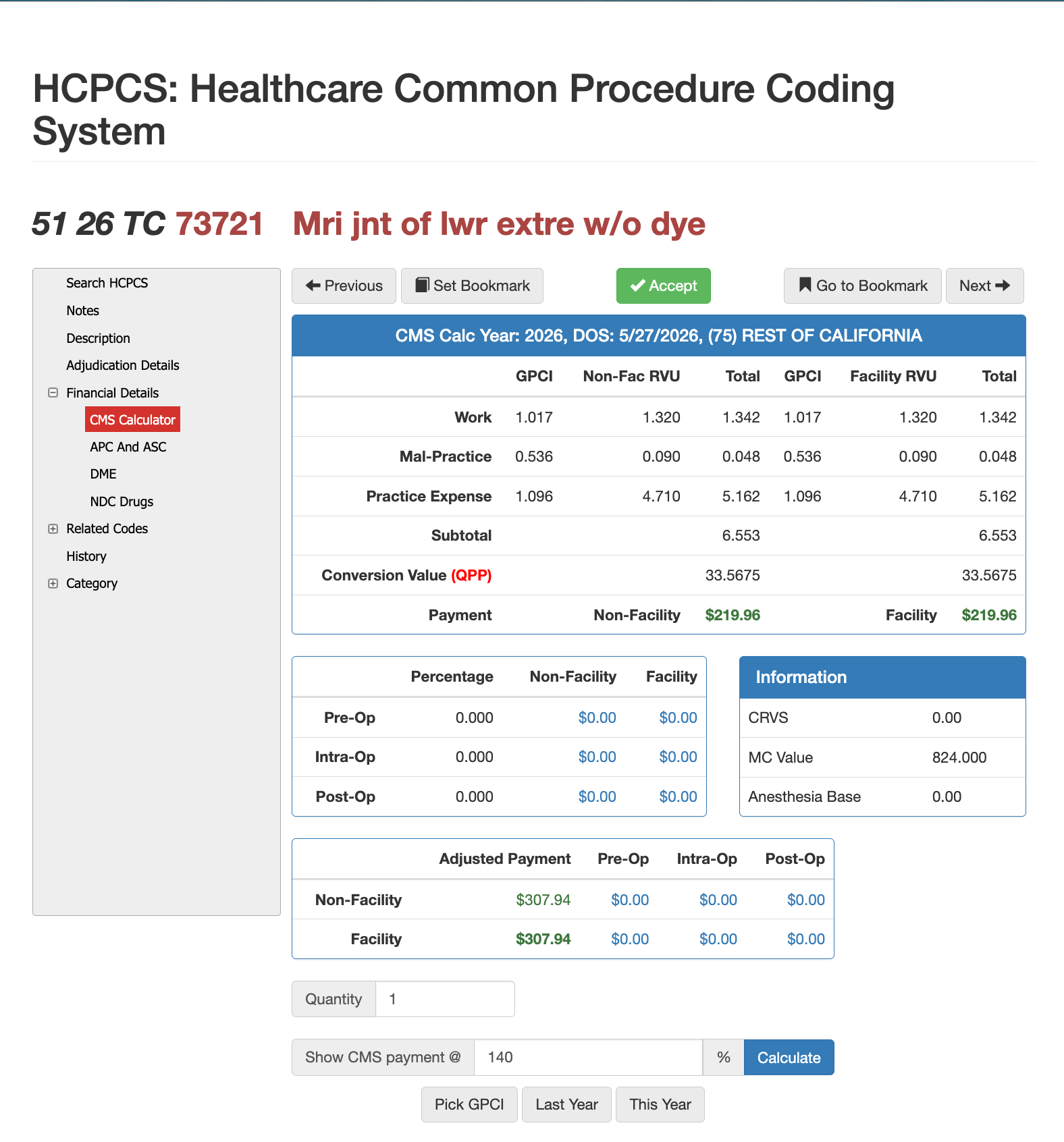
CPT Code 73721 Financials
MRI imaging codes like 73721 carry significant reimbursement variation across:
- Medicare
- Commercial PPOs
- Managed Medicaid
- MSOs
- TPAs
Using Virtual AuthTech® or iVECoder® allows organizations to:
- Compare reimbursement percentages
- Evaluate GPCI differences
- Analyze APC reductions
- Detect underpayments
- Validate modifier logic
- Identify coding inconsistencies
Payer organizations frequently audit high-volume MRI claims because advanced imaging is a major area of exposure for utilization management and payment integrity.
The Easier Way to Research Codes
CPT 73721 is one of the most commonly billed orthopedic and radiology imaging codes in outpatient healthcare. Because MRI claims involve authorization rules, modifier complexity, RVU calculations, APC reductions, and strict medical-necessity standards, both providers and payers face significant compliance risks when documentation or coding is incomplete.
PCG Software’s Virtual Examiner®, VEWS™, Virtual AuthTech®, and iVECoder® platforms help organizations:
- Validate MRI coding accuracy
- Review authorization logic
- Analyze reimbursement
- Detect bundling conflicts
- Improve payment integrity
- Reduce denials and audit exposure
Instead of manually researching fee schedules, modifier rules, imaging edits, and diagnosis support requirements across multiple systems, organizations can centralize coding intelligence through PCG’s AI-powered healthcare coding platforms.
About PCG
For more than 30 years, PCG Software has helped health plans, provider organizations, and delegated entities improve coding accuracy, payment integrity, compliance, and fraud, waste, and abuse detection through payer-focused software and claims auditing expertise.
Click to share with others