Healthcare Turnover is Undermining Payer Performance and Automation won't fix it
Summary: Healthcare turnover has become a hidden cost driver for payer organizations—impacting claims accuracy, compliance exposure, implementation timelines, and overall financial performance. While automation and AI software can dramatically improve efficiency, those tools only perform as intended when deployed into stable, adequately staffed operations. This article examines current healthcare turnover trends through a payer lens and outlines practical strategies to reduce disruption, protect institutional knowledge, and ensure technology investments deliver measurable returns.
Why Turnover Hits Payors Differently than Providers
Turnover inside payer organizations creates systemic risk rather than isolated disruption. When a claims examiner, auditor, or compliance lead leaves, the loss is not limited to a single role—it removes policy interpretation consistency, historical context, and decision defensibility. Claims continue to be processed, authorizations continue to be adjudicated, and audits continue to mature, often with fewer guardrails. Unlike provider organizations, payers cannot offset turnover by redistributing patient care. Errors compound quietly, surfacing later as recoveries, appeals, regulator findings, or provider abrasion. Over time, this instability increases financial exposure and weakens trust across the ecosystem.
Payer Turnover Impact on Ecosystem
Leadership and operational turnover remain elevated across healthcare, but the downstream impact is particularly acute for payers. Executive turnover frequently disrupts long-term strategy, vendor continuity, and compliance governance. Each leadership change introduces new priorities, system reviews, and process resets—often delaying or derailing ongoing initiatives. Turnover within the claims, coding, and audit teams poses an even greater risk. These roles carry institutional knowledge that is difficult to document thoroughly. When experienced staff exit, organizations experience backlogs, inconsistent determinations, increased rework, and rising appeal volumes. The financial impact often exceeds salary replacement costs by orders of magnitude.
Turnover Trends Creating Hidden Costs for Payers
Leadership and operational turnover remain elevated across healthcare, but the downstream impact is particularly acute for payers. Executive turnover frequently disrupts long-term strategy, vendor continuity, and compliance governance. Each leadership change introduces new priorities, system reviews, and process resets—often delaying or derailing ongoing initiatives.
Turnover within the claims, coding, and audit teams poses an even greater risk. These roles carry institutional knowledge that is difficult to document thoroughly. When experienced staff exit, organizations experience backlogs, inconsistent determinations, increased rework, and rising appeal volumes. The financial impact often exceeds salary replacement costs by orders of magnitude.
Costs for Hiring and Onboarding Executives
Creating a dedicated automation track for clean claims dramatically reduces processing time and frees staff to focus on complex, high-risk submissions. By using AI-driven intake validation, code checks, and rule-based adjudication, payers can resolve a large percentage of claims without human intervention. This not only accelerates turnaround times but also reduces error rates, helping the organization consistently meet the 30-day deadline with fewer resources and less operational strain.
Cost for Hiring & Onboarding Claims and Compliance
Real-time dashboards that track claim aging by the hour—not the day—give operational leaders the visibility needed to intervene before claims approach the 30-day threshold. These tools highlight stalled claims, routing delays, and emerging bottlenecks, allowing teams to reassign work, escalate reviews, or trigger automated edits early. Moving from weekly or daily reporting to continuous monitoring is one of the fastest ways to prevent deadline violations under the new law.
The Member and Provider Impact of Payer Turnover
While members rarely see internal payer staffing changes directly, they experience the effects through delayed decisions, inconsistent authorizations, and unpredictable appeals outcomes. Providers, in turn, experience increased friction when determinations vary or timelines stretch due to internal instability. Over time, these operational gaps translate into reputational risk, regulator attention, and contractual strain—particularly for managed care, PACE, and value-based arrangements.
Provider Turnover Rates in 2025
Provider turnover remains one of the most destabilizing forces in healthcare operations entering 2025. National estimates continue to show annual physician turnover ranging between 6% and 9%, with significantly higher rates among early-career providers and primary care specialties. Advanced practice providers (NPs and PAs) experience even higher mobility, often exceeding 10–12% annually, driven by workload pressure, administrative burden, and compensation compression.
For payer organizations, provider turnover creates downstream volatility that extends well beyond network contracting. Frequent provider exits disrupt continuity of care, increase authorization variability, and drive higher appeal volumes as coverage determinations are reinterpreted by new clinical staff. These changes introduce noise into utilization patterns, quality metrics, and risk adjustment accuracy—often months after the turnover event occurs.
From an operational standpoint, high provider turnover also increases payer workload indirectly. Credentialing cycles restart, medical policy education must be repeated, and retrospective reviews become more complex when documentation practices change. In managed care, these effects compound across value-based contracts, PACE models, and delegated entities, increasing both financial exposure and compliance risk.
Nurse Turnover Rates in 2025
Nurse turnover continues to exceed sustainable levels across U.S. healthcare systems in 2025. While rates have stabilized slightly from pandemic highs, hospital RN turnover remains elevated at approximately 20–25% annually, with some specialties—emergency, behavioral health, and critical care—experiencing significantly higher churn. Contract and travel nursing has declined from peak levels, but workforce instability persists.
For payers, nurse turnover impacts far more than provider organizations realize. Nurses play a central role in utilization management, care coordination, discharge planning, and documentation quality. When experienced nursing staff exit, gaps emerge in clinical narratives, authorization justifications weaken, and post-acute utilization becomes harder to manage consistently.
High nurse turnover also places strain on payer-provider relationships. Delays in care coordination, inconsistent clinical documentation, and fluctuating staffing models increase friction during audits and appeals. Over time, these inefficiencies translate into higher administrative costs, slower turnaround times, and increased scrutiny from regulators focused on access, timeliness, and medical necessity determinations.
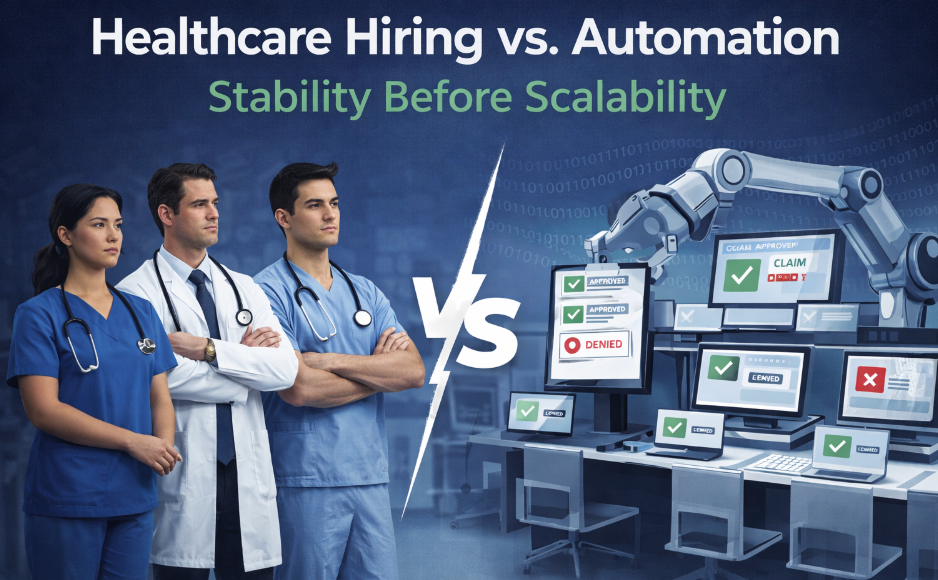
Why Automation Alone Cannot Solve Turnover

Automation Builds Systems, Not People's Skills or Experience
Automation does not replace expertise—it standardizes it. When payer organizations introduce AI, rules engines, or adjudication platforms into high-turnover environments, those systems often reflect the same inconsistencies they were meant to resolve. If policies are undocumented, thresholds are debated internally, or escalation rules vary by reviewer, automation amplifies variability rather than correcting it. From an implementation standpoint, this is one of the most common reasons payer technology projects stall or underperform.
From an outside implementation perspective, successful payer organizations take a disciplined approach before introducing new platforms. First, core claims, audit, and compliance roles must be fully staffed and supported. Automation should enhance experienced teams—not compensate for missing expertise. Second, organizations must document coverage policies, thresholds, and exception handling in a way that is internally agreed upon. Finally, leadership must address workload imbalance and burnout before adding system complexity.
PCG Case Study: Automation Before Operational Readiness
Implementing automation before staffing stabilizes often leads to rework, delayed go-lives, and staff resistance.
PCG Example: In our 30-year history with over 500 trainings, our number one issue for payer organizations is not the willingness to use our claims auditing software, it's having the right leadership and claims examiners and compliance members in place.
Our solution helps aide the working staff making faster, more compliant decisions, but the people who use that information must have experience and knowledge to interpret governmental regulations, contracts, and understand the language of medical claims.
Training Fatigue, Productivity, Improvement
Both the payer organization and software vendors get exhausted with continuous training. While it's needed to stay relevant, the greater experience your staff has, the faster the training can go. This means that you may have to include financial incentives for updating training to team members, while explainiing that productivity cannot be decreased significantly while they learning updates and new skills.
Payer Employee Incentive Programs We've Seen Work
Sustainable retention in payer organizations is driven by clear incentives, fair compensation, and transparent career progression. Employees who understand how they are evaluated, rewarded, and promoted are more likely to remain engaged, accountable, and aligned with organizational goals. Incentive structures should reinforce accuracy, compliance, and long-term value—not just speed or volume.
Competitive Salary and Benefits
Competitive base compensation is the foundation of retention. Payer organizations must benchmark salaries against regional and national healthcare markets, factoring in specialization, certification, and experience. Comprehensive benefits—health coverage, retirement contributions, paid time off, and flexible work arrangements—signal long-term commitment and reduce attrition driven by marginal pay differences elsewhere.
Bonus for Exceptional Audit Performance
Performance bonuses tied to audit quality—not just quantity—encourage accuracy, defensibility, and compliance. Metrics may include upheld denials, overturned appeal rates, documentation accuracy, and adherence to CMS and AMA standards. Rewarding quality outcomes reinforces responsible decision-making and reduces downstream audit risk.
Bonus for Membership Growth and Financial Impact
Incentives aligned with organizational growth help employees see how their work contributes to the broader mission. Bonuses tied to membership growth, medical cost containment, or measurable reductions in improper payments align individual performance with payer sustainability while avoiding volume-based pressure that can compromise compliance.
Licensing, Certification, and Educational Merit Pay
Clear merit-based pay increases tied to certifications and continuing education promote professional development and institutional expertise. Support for CPC, CCS, RN, MD review roles, compliance training, and regulatory education strengthens internal capabilities while signaling that knowledge advancement is valued and rewarded.
Defined Promotion Path and Leadership Ladder
Retention improves when employees can see a future within the organization. A clearly defined hierarchy—from analyst to senior analyst, lead, manager, and director—sets expectations and motivates performance. Promotion criteria should be transparent, competency-based, and aligned with leadership readiness, not tenure alone.
Internal Staffing versus Outsourcing

Why Internal Payer Teams Outperform Outsourcing
Organizations that invest in internal hiring and retention build continuity across claims, utilization management, compliance, and leadership functions. Internal staff develop shared standards, consistent decision logic, and accountability that aligns with organizational risk tolerance. This consistency is critical for payer defensibility during audits, appeals, and regulatory review.
From a governance standpoint, internal teams support long-term goal alignment. Performance metrics, incentive structures, and compliance priorities evolve with organizational strategy rather than vendor constraints. This creates stable leadership pipelines, reduces rework, and improves cross-department collaboration—outcomes that outsourcing models struggle to sustain.
Financially, internal staffing also delivers compounding returns. While outsourcing may appear less expensive in the short term, costs increase over time through contract renewals, change orders, retraining cycles, and quality drift. Internal teams improve year over year, reducing error rates and increasing efficiency without resetting institutional knowledge.
Compliance Discussion with Outsourcing
Healthcare compliance is not static. Regulations, enforcement priorities, and audit expectations shift continuously. Internal teams adapt faster because they operate inside the organization’s policies, data, and leadership framework. Outsourced teams, by contrast, operate across multiple clients and risk profiles, limiting their ability to fully internalize payer-specific compliance nuances. When enforcement actions occur, accountability ultimately rests with the payer—not the vendor. Organizations with strong internal compliance and audit teams are better positioned to respond, remediate, and defend decisions. Long-term outsourcing weakens this posture by diluting ownership of policy interpretation and risk management.
When Outsourcing Makes Sense for Payer Organizations
Outsourcing should be used deliberately and sparingly. It is most effective for short-term projects, transitional periods, or capacity gaps—not as a permanent operating model. Used correctly, outsourcing buys time. It should never replace the goal of building a capable, accountable internal workforce.
Examples include:
- Temporary staffing during turnover recovery
- One-time remediation or backlog reduction
- Specialized projects with defined scope and endpoints
- Support functions while internal teams are rebuilt
Conclusion: Stabilize People Before You Scale Technology
Healthcare turnover is not just a staffing issue—it is a structural risk that directly undermines payer performance, compliance, and technology ROI. Automation, AI, and advanced adjudication platforms can dramatically improve efficiency, but only when deployed into stable, well-trained, and accountable teams. When turnover remains unresolved, technology amplifies inconsistency instead of correcting it.
Payer organizations that succeed long-term take a deliberate approach: they invest first in internal talent, clear incentives, leadership continuity, and operational readiness. Outsourcing is used tactically, not permanently. Technology is layered on after teams are prepared to govern, interpret, and defend decisions. This sequence—people, process, then platforms—is what turns automation into an asset instead of a liability. Stabilizing your workforce is not a delay to innovation. It is the prerequisite that allows innovation to deliver measurable, defensible, and sustainable results.
About PCG
For more than 30 years, PCG Software has helped health plans, provider organizations, and delegated entities improve coding accuracy, payment integrity, compliance, and fraud, waste, and abuse detection through payer-focused software and claims auditing expertise.
Click to share with others