
DME Healthcare Fraud, Waste, and Abuse Library
Purpose of this Live Article:
As your premier resource for combating fraud, waste, and abuse, PCG aims to update this DME fraud article every time the DOJ, OIG or state attorneys general report convictions or settlements involving durable medical equipment (DME). Like our home health care library, this page will grow as new cases are resolved – exposing kickback schemes, false claims, unqualified providers, shell companies, fraudulent patient orders and other schemes that cheat taxpayers and endanger beneficiaries. Our goal is to provide payers, regulators, and compliance teams with a living timeline and a trusted reference for understanding how DME fraud occurs and how to prevent it.
DME Fraud is a Growing Threat
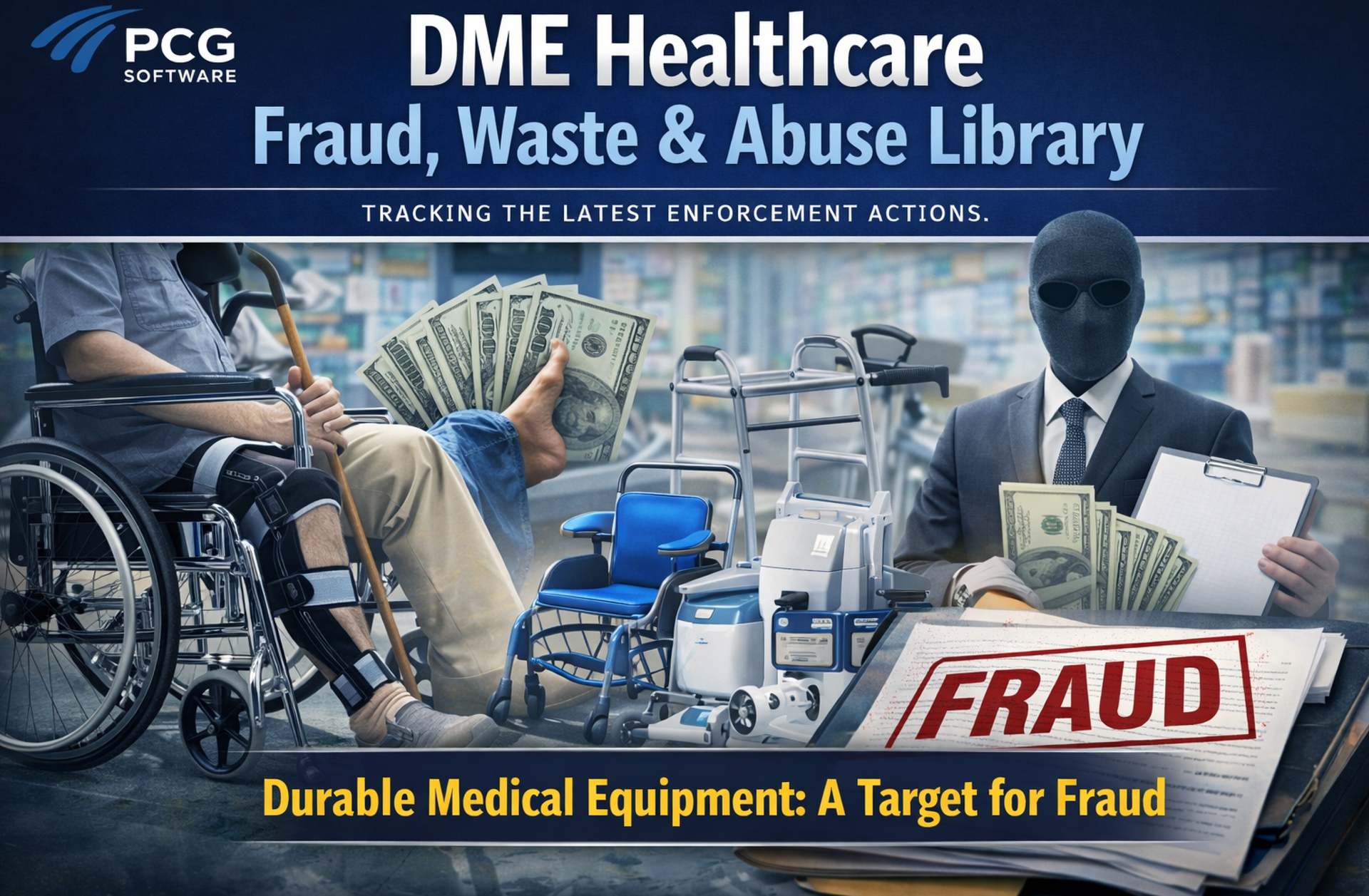
Durable medical equipment includes orthotic braces, wheelchairs, diabetic supplies, hospital beds, and other devices that help patients live independently. Medicare and Medicaid reimburse suppliers when doctors certify that beneficiaries need these items. During the pandemic, telemedicine accelerated DME prescribing. Unfortunately, the sector’s rapid growth and high reimbursement rates also attracted bad actors. Between 2024 and 2025, federal and state investigators uncovered multi‑million dollar schemes involving telemarketing call centers, telemedicine providers, shell companies and fake owners. These cases reveal how fraudsters exploited remote prescribing, lax ownership rules, and complex supply chains to submit false claims and pay illegal kickbacks. The enforcement actions below illustrate what happens when oversight fails – and what compliance teams can learn.
2026 DME Fraud Cases
$2M Loss & 18 Months Prison – Kestrel Medical (Jan'2025)
Beginning in 2018, Mr. Bruce Johnson, owner of Kestrel Medical in Wisconsin, defrauded Medicare by submitting claims for orthotic devices totaling $2 million. Johnson paid kickbacks to companies in exchange for physician signatures and referrals to his DME company. Prior to final actions, Kestrel Medical filed for bankruptcy, and Johnson attempted to transfer $150,000 to one of Comino's companies to divest and shelter the money.
Source:
Beckers
Action: Restitution and Prison time; $2M in fines, 18 months prison, 3 Years supervised probation.
2025 DME Fraud Cases
$452M Restitution & 15-Year Sentence – DMERx Founder - Dec 2025
In December 2025 the CEO of DMERx, a health‑care software company, was sentenced to 15 years in federal prison and ordered to pay more than $452 million in restitution. Prosecutors said the CEO created an online platform that generated false doctors’ orders for orthotic braces and pain creams. Telemedicine physicians were paid kickbacks to sign orders without examining patients, and DME suppliers used the orders to bill Medicare and other insurers for more than $1 billion. Telemarketers targeted seniors, misrepresented their contacts and funneled beneficiaries into the scheme. The CEO concealed the arrangement through sham marketing contracts and shell companies.
Source:
DOJ Report
Action: Sentencing; restitution; long prison term; corporate forfeiture
$172M Restitution & 87-Months Prison - Aaron Williamsky - Nov 2025
A New Jersey business owner was sentenced to 87 months in prison and ordered to pay over $172 million in restitution for orchestrating one of the largest DME fraud schemes in history. From 2015 through 2021, he opened or purchased more than 20 DME companies and paid marketing firms for leads. He disguised kickbacks as marketing expenses and used shell companies and foreign accounts to launder proceeds. The companies submitted fraudulent claims to Medicare for orthotic braces that were not medically necessary.
Sources:
DOJ Report
Action: SSentencing; restitution; forfeiture; multi‑year conspiracy dismantled.
$7.8M False Claims - Jesse Foote - Dec 2025
Connecticut resident Jesse Foote was sentenced to 30 months in prison and ordered to pay $7,878,991.56 in restitution for conspiring with telemarketers, telemedicine companies, doctors and DME suppliers to defraud Medicare. Between 2017 and 2021, Foote bought patient leads and paid bribes to telemedicine providers and physicians to obtain orders for orthotic braces. He then sold the signed orders to DME suppliers, which submitted false claims totaling more than $7.8 million.
Source:
DOJ Report
Action: Sentencing; restitution; telemarketing scheme exposed.
$21.2M Restitution, $2.5M Forfeiture & 12-Years Prison – Peter Roussonicolos - July 2025
Florida DME owner Peter Roussonicolos received 12 years in prison and three years of supervised release for running a $61.5 million Medicare fraud. Despite prior felony convictions, he secretly owned five DME suppliers by recruiting nominees to act as front owners. He falsified enrollment forms and knew that co‑conspirators paid kickbacks to patient recruiters. The companies submitted $61.5 million in false claims for orthotic braces and received $26.7 million in payments. The court ordered restitution of $21.2 million and forfeiture of $2.5 million.
Source:
OIG Report
Action: Sentencing; restitution and forfeiture; exclusion from federal programs.
$3.95M Restitution & 18‑Month Sentence – Telemedicine NP - Apr 2025
Convicted in 2024 but sentenced in 2025. A Virginia‑based nurse practitioner was sentenced to 18 months in prison, followed by two years of supervised release (with one year home confinement), and ordered to pay $3,952,761 in restitution. From December 2018 to April 2020 she worked with a telemedicine company to sign over 2,000 orders for orthotic back and knee braces without assessing patients. Telemarketing firms pre‑populated orders, and she signed them electronically in seconds. The orders were sold to DME suppliers, causing Medicare to pay more than $7.8 million for medically unnecessary braces.
Source:
OIG Report
Action: Sentencing; restitution; telemedicine prescribing abuse penalized.
2024 DME Fraud Cases

$1.7M Restitution, $20k Fine, 5 Years Prison - Edelmira Marquez - Dec 2024
The owner of Marquez Medical Supply in El Paso was sentenced to 60 months (five years) in prison, fined $20,000, and ordered to pay $1,739,608.59 in restitution to Medicaid and Medicare. She substituted lower‑value adult diapers, wipes, and bed liners while billing Medicaid and Medicare for higher‑value products. She pleaded guilty and was remanded to custody upon sentencing.
Source:
DOJ Report
Action: Sentencing; restitution; fraud proceeds forfeited.
$34M Restitution, 10 Year Prison - Dr. Daniel R. Canchola - Oct 2024
Texas physician Daniel R. Canchola was sentenced to 10 years and one month in prison and ordered to pay more than $34 million in restitution. Canchola signed thousands of false orders for DME and cancer genetic tests without seeing patients. Telemarketers prepared orders; he was paid about $30 per order and received roughly $466,000 in kickbacks. His orders generated $54 million in fraudulent claims.
Source:
DOJ Report
Action: Sentencing; restitution; physician excluded from federal programs.
$4.4M Restitution, 26 Months Prison - Dr. Ankita Singh - July 2024
Ohio doctor Ankita Singh was sentenced to 26 months in prison and ordered to pay $4.47 million in restitution after signing more than 11,000 orders for orthotic braces prepared by telemarketers. She never examined the patients. The scheme resulted in more than $8 million in claims to Medicare; Medicare paid approximately $4.47 million.
Source:
DOJ Report
Action: Sentencing; restitution; telemedicine prescribing crackdown.
Breakdown of DME Fraud Schemes
Illegal Kickbacks and Telemarketing Schemes
Nearly every major DME case involved illegal kickbacks paid to telemarketers, physicians or shell companies. Operators like DMERx and Williamsky paid marketing firms for leads and disguised kickbacks as consulting fees or advertising expenses. Telemarketing companies cold‑called Medicare beneficiaries, collected personal information and generated pre‑populated orders for orthotic braces. Physicians and nurse practitioners were then paid to sign these orders without examinations, after which DME suppliers billed Medicare. Some defendants also bribed doctors directly, as in the Foote and Canchola cases. Telemarketing companies cold‑called Medicare beneficiaries, collected personal information and generated pre‑populated orders for orthotic braces. Physicians and nurse practitioners were then paid to sign these orders without examinations, after which DME suppliers billed Medicare. Some defendants also bribed doctors directly, as in the Foote and Canchola cases
False Claims and Unqualified Services
Fraudsters routinely billed Medicare and Medicaid for products that patients did not need or for more expensive products than were delivered. Marquez Medical Supply swapped lower‑cost adult diapers for higher‑reimbursed items. Physicians such as Canchola and Singh signed orders for braces and genetic tests without ever seeing patients. Telemedicine nurse practitioners like Daphne Jenkins electronically signed hundreds of orders in seconds. These false certifications allowed suppliers to submit millions in claims for unqualified or medically unnecessary equipment. Unqualified employees also played a role: some DME companies hired individuals to pose as doctors or nurses to sign forms, and several owners hid their prior convictions by using nominees
Shell Companies and Money Laundering
Larger schemes used shell companies to hide ownership and launder proceeds. Peter Roussonicolos secretly owned five DME suppliers through nominees and falsified enrollment forms. Williamsky laundered revenue through shell corporations and foreign bank accounts. Such tactics obscured the flow of kickbacks and made it harder for auditors to trace funds. These networks also allowed fraudsters to shift operations quickly when one entity was shut down.
Telemedicine Exploitation
Telemedicine, intended to improve access to care, became a vehicle for DME fraud. Telemarketers collected patient information, telemedicine providers signed pre‑populated orders without contact, and suppliers billed for braces. Cases like DMERx, Foote, Gidwani, Canchola, Singh, and Jenkins show how remote prescribing and DocuSign orders were abused. These patterns suggest the need for tighter telemedicine controls and verification of provider‑patient relationships before DME orders are processed.
DME Fraud Typologies
Telemedicine, intended to improve access to care, became a vehicle for DME fraud. Telemarketers collected patient information, telemedicine providers signed pre‑populated orders without contact, and suppliers billed for braces. Cases like DMERx, Foote, Gidwani, Canchola, Singh, and Jenkins show how remote prescribing and DocuSign orders were abused. These patterns suggest the need for tighter telemedicine controls and verification of provider‑patient relationships before DME orders are processed.
How the Fraud Schemes Worked
DME fraud schemes generally followed a three‑part pattern:
- Lead Generation & Telemarketing – Marketing firms or telemarketers called Medicare beneficiaries, promising free braces or equipment. They collected personal and insurance information and forwarded it to telemedicine providers or shell DME companies.
- Fake or Improper Prescriptions – Telemedicine providers (nurse practitioners, physicians) signed mass quantities of pre‑filled orders without examining patients. In many cases, providers were paid per order. Some physicians, like Canchola, received $30 per order and generated more than $54 million in claims. Others, like Jenkins, signed orders within seconds.
- Billing & Laundering – DME companies submitted claims using these bogus orders. Payments were laundered through shell entities and foreign accounts. Owners disguised kickbacks as marketing fees or management services and used nominees to hide their involvement.
When regulators uncovered one company, operators simply shifted to another entity.
Why DME Fraud Flourished
Several factors made the DME sector vulnerable during 2024–2025:
- Remote Prescribing – The pandemic expanded telemedicine, but regulations lagged. Providers could sign large numbers of orders without meeting patients, enabling telemarketing schemes.
- High Reimbursement & Low Entry Barriers – Orthotic braces and pain creams command high reimbursements relative to cost, and setting up a DME company is relatively easy. Unscrupulous owners exploited this by setting up multiple shell suppliers.
- Complex Supply Chains – Many players are involved (telemarketers, doctors, DME suppliers). Each participant could claim ignorance of the full scheme, making enforcement harder.
- Weak Ownership Controls – Medicare enrollment processes allowed convicted felons to control suppliers through nominees.
- Limited Real‑Time Oversight – Auditors typically review claims after payment. By then, fraudsters may have laundered proceeds or moved to new entities.
Summary of DME Fraud

What this means for Payers
DME enforcement actions offer important lessons for health plans and managed care organizations. Prescribing patterns, particularly high DME order volumes or telemedicine reliance, require closer scrutiny. Advanced data analytics can help identify outlier behaviors. Payers must monitor referral and financial relationships to avoid disguised kickbacks, necessitating full disclosure of financial ties evaluated against fair-market-value standards.
Enrollment controls for DME suppliers are essential. Health plans should verify that supplier owners and executives have no prior exclusions or criminal history and assess nominee ownership structures for concealed control. Documentation audits are critical for fraud prevention. Orders must be verified for completeness and legitimacy, with beneficiary outreach confirming the need for equipment; high denial rates can suggest fraud. Lastly, collaboration with enforcement agencies is vital. Reporting suspicious activity to CMS aids coordinated investigations revealing hidden multi-state schemes.
Red Flag and Fraud Indicators
DME fraud cases show clear operational and behavioral red flags that compliance teams should monitor. A common indicator is an unusually high volume of orders, especially when providers sign hundreds of prescriptions per week or exceed peer benchmarks by a significant margin. Another signal is the use of pre-populated forms and rapid electronic signatures. Orders completed in seconds may suggest providers are signing without reviewing patient records or confirming medical necessity. Patient reports of unsolicited calls offering “free” equipment also indicate potential fraud linked to lead-generation schemes.
Shell company patterns are noteworthy risks. DME suppliers sharing addresses or ownership with excluded entities often employ complex structures to evade detection. Disguised payments also signal fraud. Large fees paid to physicians or lead generators without documented services frequently conceal illegal referral arrangements. Geographic inconsistencies raise concerns, especially when providers in one state order equipment for patients nationwide without proper patient interaction.
Enforcement and Millions in Savings
Between 2024 and 2025 alone, federal and state authorities secured hundreds of millions of dollars in restitution orders, fines, and forfeitures related to DME fraud, while imposing lengthy prison sentences on business owners and physicians. Regulators consistently emphasized that DME fraud harms not only taxpayers but also patients who may receive inappropriate equipment or be denied medically necessary care.
The scale and severity of penalties reinforce a clear message: DME is no longer a low-risk environment for fraud. Individuals and organizations that violate program rules increasingly face criminal prosecution, financial ruin, and lifetime exclusion from federal healthcare programs.
Using AI Auditing to Prevent Home Healthcare Fraud
As DME fraud schemes increase in scale and sophistication, traditional post-payment audit models that rely on sampling and retrospective review are no longer sufficient. Artificial intelligence enables a fundamentally different approach by analyzing claims at the individual level and at scale. AI-driven platforms such as Virtual Examiner® evaluate 100 percent of claims every day, comparing provider behavior across populations, reviewing documentation timestamps, and correlating orders with telemedicine activity.
By identifying anomalies such as providers signing hundreds of orders within minutes or suppliers billing for patients across multiple states, AI systems can flag potential fraud before payments are issued. This shift from retrospective recovery to continuous, real-time monitoring allows payers to limit non-compliance, preserve program funds, and protect beneficiaries without disrupting legitimate care delivery. AI auditing introduces modern oversight into a sector historically dependent on trust and paper signatures.
About PCG
For more than 30 years, PCG Software has helped health plans, provider organizations, and delegated entities improve coding accuracy, payment integrity, compliance, and fraud, waste, and abuse detection through payer-focused software and claims auditing expertise.
Click to share with others